Categories
新闻资讯-澳洲移民_en

How to Choose an Australian Immigration Pathway in 2026: A Complete Comparison of Common Visa Options

When many people first start researching Australian Immigration(澳洲移民), the problem is often not that there are too few options. It is that there are simply too many.

You have subclass 189, 190, 491, 482, 186, 494 and 485 visas, plus Partner Visas, Parent Visas, the National Innovation Visa and more. Every pathway looks possible at first glance. But once you compare them properly, the differences become much clearer.

Some pathways require you to compete for points. Some depend on finding the right employer. Some require extensive evidence of a genuine relationship. Others involve significant time or financial commitments.

So when choosing an Australian migration pathway, do not focus only on asking:

“Which visa is the most popular right now?”

A better question is:

“Which pathway is the most realistic for me, carries the least risk and fits the timeframe I can actually manage?”

According to the Department of Home Affairs’ 2025–26 Permanent Migration Program, Australia allocated 185,000 permanent migration places for the financial year. Of these, 132,200 places were allocated to the Skilled stream, representing around 71%, while the Family stream received 52,500 places, or around 28%.

The overall direction of Australian migration in 2026 therefore remains clear: skills, employment and family reunion continue to be the main pillars.

But the real question is: where should you start?

What Are the Main Australian Immigration Pathways in 2026?

The first step is to understand the overall structure.

Australian immigration is not one single pathway. It consists of several very different routes.

Skilled Migration: Subclass 189, 190 and 491 Visas

Skilled migration is mainly assessed based on your occupation, age, English ability, qualifications, work experience, skills assessment and EOI points score.

Common visas include:

Subclass 189 Visa (Skilled Independent visa): Its biggest advantage is independence. You do not need state nomination or employer sponsorship.

Skilled Nominated Visa 190(190签证): Suitable for applicants who are willing to align with a particular state’s migration policy and whose occupation and background match the state’s nomination requirements.

Subclass 491 Visa (Skilled Work Regional visa): Suitable for applicants willing to live and work in regional Australia and build a longer-term migration plan through a regional pathway.

SkillSelect makes it clear that subclass 189, 190 and 491 visas are points-tested visas. Applicants generally need at least 65 points to be eligible for an invitation.

However, 65 points is only the minimum threshold. It does not guarantee that you will receive an invitation.

Your occupation, competition within each invitation round and individual state nomination policies can all affect your chances.

Employer Sponsorship: Subclass 482, 186 and 494 Visas

Employer sponsorship is more closely connected with employment.

In simple terms, if an Australian employer is willing to offer you a genuine position, and your occupation, experience, salary and the employer’s business circumstances meet the relevant requirements, an employer-sponsored pathway may be available.

Common visas include:

Subclass 482 Visa (Skills in Demand visa): Allows employers who cannot find a suitable local worker to sponsor an eligible overseas skilled worker for a genuine position.

Employer Nomination Scheme 186(186签证): Suitable for applicants with ongoing employer support, a genuine and stable position and the required occupational and work experience background.

Subclass 494 Visa (Skilled Employer Sponsored Regional visa): Suitable for applicants with an employer opportunity in regional Australia who are willing to live and work in a regional area.

The advantage of employer sponsorship is that you do not need to compete for a very high EOI points score in the same way as points-tested skilled migration.

However, this pathway depends heavily on the employer.

Whether the company is willing and eligible to sponsor, whether the position is genuine, whether the salary meets the requirements and whether the business can satisfy sponsorship obligations can all affect the application.

Study-to-Migration Pathway: Student Visa 500, Graduate Visa 485 and PR Options

Studying in Australia is not itself a migration visa pathway, but many applicants follow a route such as:

Student Visa 500 → Temporary Graduate Visa 485 → subclass 190 / 491 / 482 / 186 or another permanent pathway.

The subclass 485 visa can provide graduates with time to improve English, complete a skills assessment, gain relevant work experience and prepare for another migration pathway.

This approach can suit people who do not yet have a mature professional background and want to build qualifications and local experience in Australia.

However, it can involve significant time and financial costs.

Choosing the wrong course can also create problems. A common situation is completing a qualification only to discover that it does not lead smoothly to a suitable skills assessment, or that the target state does not offer a practical nomination pathway for that occupation.

For this reason, migration planning should ideally begin before choosing a course, not after graduation.

Partner and Family Migration: 820/801, 309/100, 300 and Parent Visas

If your partner is an Australian citizen, permanent resident or eligible New Zealand citizen, an Australian Partner Visa(澳洲配偶签证) may be available.

Common pathways include:

Subclass 820/801 Partner Visa: Generally suitable for applicants applying from inside Australia. The pathway normally begins with temporary residence before progressing to permanent residence.

Subclass 309/100 Partner Visa: Generally suitable for applicants applying from outside Australia, also typically involving a temporary stage followed by permanent residence.

Subclass 300 Prospective Marriage Visa: Suitable for couples in a genuine relationship who intend to marry but have not yet completed their marriage registration.

These visas do not rely on occupation lists, EOI points or skills assessments.

However, they place significant emphasis on the genuineness of the relationship.

Evidence may include shared living arrangements, financial arrangements, social recognition, future plans, communication records and other documentation showing that the relationship is genuine and continuing.

Parent visas involve a different set of considerations, particularly time and cost.

Subclass 103 Parent Visa, Subclass 143 Contributory Parent Visa and Subclass 870 Sponsored Parent Temporary Visa can differ significantly.

Some involve very long waiting periods. Some involve much higher costs. Others provide only temporary family reunion rather than permanent residency.

So before asking whether a parent visa is technically available, families should first ask:

Is this pathway worth the waiting time and cost for our family circumstances?

Innovation and Special Pathways: National Innovation Visa 858

The National Innovation Visa 858 is a permanent residence visa for people with internationally recognised records of exceptional achievement in selected fields.

Officially, applicants are expected to demonstrate an internationally recognised record of exceptional and outstanding achievement.

This is not simply a replacement for the former investor migration model where financial capacity alone determines eligibility.

It is more relevant to people with significant achievements in areas such as research, innovation, the arts, sport or selected business and professional fields.

Comparison of Common Australian Immigration Pathways

Migration Pathway Common Visa Main Advantage Main Challenge May Suit
Independent skilled migration 189 No state or employer dependency, high PR flexibility Strong competition and high points High-scoring applicants with in-demand occupations and strong English
State-nominated skilled migration 190 State nomination creates more strategic options State policies can change quickly Applicants willing to build a future in a particular state
Regional skilled migration 491 More regional opportunities Regional residence and later PR requirements Applicants willing to live in regional Australia
Temporary employer sponsorship 482 Closely linked to employment, no need for a very high EOI score Depends heavily on employer and position Applicants with genuine Australian employment opportunities
Employer-nominated permanent residence 186 Can provide a direct or transitional PR pathway Strict employer, position and experience requirements Applicants with stable employer support
Regional employer sponsorship 494 Suitable for regional employer opportunities Regional and later PR requirements Applicants with employer opportunities in regional Australia
Study-to-migration pathway 500 / 485 Builds Australian qualifications and local experience High time and financial cost, course selection is critical Applicants without an established professional background
Partner migration 820/801, 309/100, 300 No occupation or points test Strong relationship evidence required Applicants in genuine and stable relationships
Parent migration 103, 143, 870 Supports family reunion Long waiting times or high costs Families with children settled in Australia
Innovation pathway 858 / NIV Suitable for high-achieving applicants High eligibility threshold and narrow target group High achievers in research, innovation, business and related fields

Of course, the right pathway depends on what you already have.

Do you have a suitable skills assessment?

Do you have an employer?

Do you have strong and well-documented relationship evidence?

Do you have enough time to improve your English?

Can your budget support a longer-term migration plan?

These factors often matter more than which visa is currently receiving the most attention online.

Which Australian Immigration Pathway Is Easier?

Many people ask:

“Which Australian immigration pathway is the easiest in 2026?”

There is no single answer because “easy” can mean very different things.

If You Value Freedom, Subclass 189 Is Attractive but Not Necessarily Easy

The appeal of subclass 189 is clear.

It does not require state nomination, it does not tie you to an employer, and once granted it provides considerable flexibility over where you live and work.

However, it generally suits applicants with competitive points, in-demand occupations, strong English and solid work experience.

If an applicant does not have a competitive points score but places all their hopes on subclass 189, they may end up waiting for a long time.

If You Want More Strategic Options, Compare Subclass 190 and 491

Subclass 190 and 491 visas allow applicants to take state policies, regional demand and their personal background into account.

Subclass 190 can suit applicants willing to build a connection with a particular state.

Subclass 491 can suit people willing to live and work in regional Australia while meeting the requirements for a longer-term pathway.

However, these options also involve uncertainty.

State nomination policies can change. Occupation lists can change. Some states may consider local study, employment history, residence status, income or labour demand.

So when planning for subclass 190 or 491, it is not enough to look only at your points score. You also need to ask whether your target state actually needs your occupation and background.

If You Want a Pathway Closely Linked to Employment, Employer Sponsorship Can Be More Direct

For applicants already working in Australia or with a clear professional direction, subclass 482, 186 and 494 employer-sponsored visas can be worth serious consideration.

The advantage is that they are connected directly to employment rather than requiring applicants to compete against a large EOI pool.

If the employer is stable, the position is genuine and the occupation and salary requirements are clear, the pathway can be more straightforward.

But this is also where the risk lies.

Changes to the employer, the position, the business or sponsorship eligibility can all affect future migration planning.

Employer sponsorship is therefore not simply:

“My boss is willing to help me, so everything is secure.”

Both the employer and the applicant still need to satisfy the relevant requirements.

Partner Migration Does Not Use Points, but Evidence Is Everything

Partner migration may appear “easier” because it does not require a skills assessment or EOI points score.

But the difficulty lies elsewhere: relationship evidence.

A marriage certificate alone does not prove everything.

A few photos together are not necessarily enough either.

The Department looks at whether the relationship is genuine, continuing and exclusive, and may consider shared living arrangements, finances, social recognition and long-term commitment.

So partner migration is not difficult because of points. It is difficult because of the level of detail required in the evidence.

Skilled Migration vs Employer Sponsorship: One Depends on Points, the Other on the Job

This is one of the most common dilemmas for applicants.

If your skills assessment is straightforward, your English is strong, your age works in your favour and your points score is competitive, skilled migration can be a strong primary pathway.

Its major advantage is independence. Your visa strategy does not necessarily depend on one employer.

However, if you already have a stable Australian employer and the position meets the relevant requirements, employer sponsorship may be more practical.

In some industries, an applicant may struggle to achieve a very high EOI score even though an employer genuinely needs their skills. In those cases, subclass 482 or 186 may deserve greater priority.

A simple way to think about it is:

  • Strong points, strong occupation and strong English: prioritise skilled migration while keeping employer opportunities open.
  • Clear employment opportunity and stable employer: prioritise employer sponsorship while also assessing state nomination options.
  • Average points and uncertain employer support: do not blindly commit to one pathway. Start with a full background assessment.

This is also why some applicants choose to speak with a Sydney Migration Agent(悉尼移民中介) or a registered migration agent during the early planning stage.

The problem is usually not that visa names are impossible to find online.

The real challenge is deciding which pathway should be your main strategy and which should remain a backup.

Australian immigration planning session comparing visa options and PR pathways

After Graduation: Subclass 485, State Nomination or Employer Sponsorship?

One of the most common mistakes international students make is treating the subclass 485 visa as a “safe period”.

In reality, a 485 visa gives you time. It does not automatically lead to PR.

A more practical approach is to confirm three things around the time you start your 485 visa.

First, Can You Obtain a Skills Assessment?

Which occupation does your course lead to?

Which assessing authority is responsible?

Do you need work experience?

Does your course content match the assessment requirements?

These questions should be answered as early as possible.

Some courses may offer strong employment prospects but do not necessarily lead to a straightforward skills assessment.

Other courses may be popular, but state nomination opportunities after graduation may be limited.

The biggest mistake in a study-to-migration strategy is:

“I will finish the course first and think about migration later.”

Second, Do You Have a Realistic State Nomination Opportunity?

Some states consider whether applicants studied, worked or lived locally, whether they are working in a related occupation and whether they meet income or employment requirements.

Do not wait until graduation to discover that your preferred state has no suitable pathway for you.

If your goal is subclass 190 or 491, it is better to monitor state nomination requirements early rather than focusing only on university rankings or course names.

Third, Can Employer Sponsorship Be a Backup?

If your industry values practical experience or there is genuine employer demand, securing relevant employment after graduation may be more valuable than simply waiting for an invitation.

During the subclass 485 period, applicants can work on both points and employer-sponsored options.

For example, you may find a related position, build experience and later assess subclass 482, 186 or 494.

Study-to-migration planning should not begin after graduation.

Ideally, the timeline starts from the day you choose your course.

Partner and Family Migration: Do Not Focus Only on Speed

Partner visas, parent visas and other family migration categories operate very differently from skilled migration.

Partner visas focus on relationship evidence.

Parent visas focus heavily on family arrangements, waiting times and financial costs.

Child, carer and remaining relative categories are narrower and require very specific eligibility assessments.

Partner Migration: Evidence Matters More Than the Visa Name

Subclass 820/801, 309/100 and 300 visas are not difficult to understand in themselves.

The difficult part is preparing the evidence.

Your relationship timeline, shared living arrangements, financial arrangements, social evidence, recognition by both families and future plans should work together to tell one consistent story.

Even where the relationship is genuine, weak evidence can create unnecessary difficulty.

Sometimes it is better to strengthen the evidence before lodging rather than rushing into an application.

Parent Migration: Decide Whether Your Goal Is Long-Term or Temporary

Parents who want to come to Australia do not necessarily need to begin with a permanent visa.

Subclass 870 temporary parent visas, subclass 600 visitor visas, subclass 143 contributory parent visas and subclass 103 parent visas all involve very different costs and waiting periods.

For many families, the right option is not simply the cheapest or the fastest.

It depends on:

  • the parents’ age
  • health
  • family budget
  • whether they need to live in Australia long term
  • how settled the children are in Australia

If Your Points Are Not High Enough, Should You Improve Your Score, Move Regional or Change Pathways?

Not having enough points does not mean you have no options.

But you first need to understand where the gap is.

If your English has significant room for improvement, improving your English may be the most direct way to increase your competitiveness.

If your skills assessment is already complete but your points are not enough, you can assess subclass 190 or 491.

If you are willing to move regional, you may consider both subclass 491 and 494.

If you already have a relevant employment opportunity, employer sponsorship may be more realistic than continuing to focus only on your EOI.

If your field of study does not align well with a migration occupation, you may need to consider further study or changing career direction.

The least advisable strategy is knowing that your score is not competitive but continuing to wait indefinitely for one result.

Waiting can be part of a migration strategy.

It should not be the entire strategy.

Three Things to Do Before Choosing an Australian Immigration Pathway in 2026

1. Start With a Full Background Assessment

Age, English, qualifications, occupation, work experience, skills assessment, employer opportunities, partner circumstances, family needs, budget and timeline all need to be considered together.

Do not only ask:

“Which pathway do I want?”

Also ask:

“Which pathway can I realistically start now?”

2. Eliminate the Pathways That Clearly Do Not Fit

Some pathways may be popular but still unsuitable for your circumstances.

For example:

  • applicants without a strong points advantage may not want to rely only on subclass 189
  • applicants without a genuine employer position should not make employer sponsorship their only strategy
  • applicants with weak relationship evidence should not rush into a Partner Visa application

Eliminating unsuitable pathways can often make migration planning much clearer.

3. Decide on a Main Pathway and a Backup

Good migration planning usually does not rely on only one option.

A better plan has one clear main pathway and one or more realistic backups.

For example:

  • Main pathway: 190. Backup: 491.
  • Main pathway: 482. Longer-term pathway: 186.
  • Main pathway: Partner Visa. Skilled migration background assessed in parallel.
  • Main pathway: 485 transition. State nomination and employer sponsorship prepared at the same time.

Still Unsure Which Pathway Fits? Break Down Your Circumstances First

If you have already read countless visa guides but still do not know what to do next, the problem may not be a lack of information.

The issue may be that your personal circumstances have not yet been turned into a clear migration strategy.

You may have more options than you think, but you still need to distinguish between:

  • pathways you can start preparing now
  • pathways that require additional conditions first
  • pathways that appear popular but do not actually suit you

For example, skilled migration depends on skills assessment, points and state nomination opportunities.

Employer sponsorship depends on the position, salary and employer eligibility.

Partner Visas depend on the strength of your relationship evidence.

Study-to-migration planning depends on your course, subclass 485 timeframe and the pathway that follows.

Australia Visa Link can assess your age, qualifications, English ability, occupation, work experience, employer opportunities, family circumstances and timeline, and compare different pathways together rather than simply telling you whether one particular visa may be available.

If you are currently deciding between skilled migration, employer sponsorship, partner migration or a study-to-migration pathway, a professional assessment can help you identify both your main pathway and realistic backup options.

Breaking down your circumstances first and then preparing the right evidence is usually far more effective than continuing to search through visa information without a clear strategy.


Categories
新闻资讯-澳洲签证_en

How Can a Subclass 482 Visa Lead to PR? A Complete Guide to Employer-Sponsored Migration in Australia

When people first hear about Employer Sponsorship(雇主担保), one of the first thoughts that comes to mind is:

“If my employer agrees to sponsor me, does that mean I can get PR directly?”

It is not quite that simple.

The Subclass 482 Visa(482签证) is a common work visa pathway, but it is still a temporary visa rather than permanent residency.

It is better understood as a way to enter the Australian workforce first. Whether you can remain in Australia permanently depends on whether you can later transition to a subclass 186, 494, 190, 491 or another pathway that better suits your long-term circumstances.

So after obtaining a 482 visa, one of the biggest risks is not that you do not understand everything at the beginning. It is assuming that everything is already secure and no longer thinking about the next step.

It is worth asking yourself early:

Can this job remain stable?

Will the employer continue to support me?

Will my occupation, salary, English, age and work experience allow me to qualify for a PR pathway later?

The Department of Home Affairs also makes the purpose of the Skills in Demand visa (subclass 482) clear: it allows employers who cannot find a suitable Australian worker to sponsor an appropriately skilled worker.

In simple terms, the logic behind the visa still comes down to three things:

a genuine position, a suitable employer and an applicant whose skills match the role.

What Are the Most Common PR Pathways After a Subclass 482 Visa?

Subclass 186: The Most Direct Employer-Nominated Permanent Residence Pathway

If you have been working steadily for an Australian employer, the position is genuine, your occupation matches the role and the employer is willing to continue supporting you, the subclass 186 Employer Nomination Scheme visa is often one of the first permanent residence pathways to consider.

The Home Affairs guidance on the subclass 186 Temporary Residence Transition Stream is straightforward: the visa allows skilled workers nominated by an employer to live and work permanently in Australia.

However, there is a common misunderstanding here:

Holding a subclass 482 visa and working for a period of time does not mean you will automatically transition to a subclass 186 visa.

Whether you can make the transition depends on many details, including:

  • whether your occupation meets the relevant requirements
  • whether your actual work duties are consistent with the nominated occupation
  • whether your employer is willing to continue nominating you
  • whether the salary and position meet the applicable requirements
  • whether you meet the English, age and work experience requirements
  • whether a skills assessment is required, depending on the stream and occupation

Some applicants do not encounter problems because they have failed to work hard. The issue is that they did not plan early enough.

For example, if the work performed during the 482 visa period is not sufficiently aligned with the occupation later nominated for permanent residency, or if the employer’s business circumstances change, this may affect future options.

The Biggest Risk When Moving from a 482 Visa to PR Is Waiting Until the Visa Is About to Expire

Many applicants feel relieved once their subclass 482 visa is granted.

It is understandable to think:

“I am finally settled. I can work for a few years and worry about PR later.”

But that approach can be risky.

A subclass 482 visa has a limited duration, and employer circumstances can also change. A company may restructure, the role may change, salary thresholds may be updated and migration policy may also change.

If you wait until your visa is close to expiry before asking, “Can I get PR?”, there may no longer be enough time to fix important gaps.

A safer approach is to start checking three things as soon as you obtain the 482 visa.

First, Check Whether Your Occupation and Actual Position Are Consistent

Your employment contract, day-to-day duties, company structure, payslips and reference letters should ideally support the occupation you may later nominate.

If your official job title suggests one occupation but your actual duties are substantially different, this may cause problems when applying for permanent residency later.

Second, Check Whether the Employer Is Likely to Remain Stable

An employer being willing to sponsor you now is one thing.

Whether the employer can continue supporting you through the next stage is another.

You should consider whether:

  • the business is financially and operationally stable
  • the position represents a genuine ongoing need
  • the employer understands its sponsorship obligations
  • the employer is willing to cooperate with a future subclass 186 or another relevant application

Third, Check What Requirements You Still Need to Meet

English, work experience, skills assessment, age, health and character requirements should not be left until the last minute.

English is a particularly common issue.

Some people assume:

“I already work in Australia, so English will not be a problem.”

But by the time they sit the required test, they may discover that they do not have enough time to improve their score.

What If the Subclass 186 Pathway Does Not Work?

There are other options.

A subclass 482 visa does not necessarily lead only to a subclass 186 visa. Your alternatives depend on your occupation, location, employer circumstances and personal profile.

Subclass 494: If Your Employer Is in a Regional Area

If your employer is located in an eligible regional area, or you are willing to work in regional Australia, the subclass 494 visa may also be worth assessing.

It is an employer-sponsored regional pathway designed for applicants who have suitable employment opportunities outside certain metropolitan areas.

When assessing a regional opportunity, you should not only ask whether the location qualifies for a visa. You should also consider whether there is genuine demand for your occupation in that region.

The Jobs and Skills Australia Occupation Shortage List allows users to explore labour shortages by occupation and state or territory, which can provide useful context when assessing employment opportunities in different areas.

However, subclass 494 should not simply be treated as a substitute for subclass 186.

It has its own regional, employer and occupation requirements, and applicants should also consider whether they genuinely want to live and work in that region over the longer term.

Australian immigration planning for 482 visa holders considering PR and employer sponsored pathways

Subclass 491: If Regional Skilled Migration Better Matches Your Profile

For some applicants, the employer-sponsored pathway under subclass 482 may not remain stable, while their skills assessment, English, points score and state nomination prospects are relatively strong.

In that situation, subclass 491 may also be worth considering.

The Skilled Work Regional Visa 491(491签证) is a provisional visa for skilled applicants who want to live and work in regional Australia. Official guidance also describes it as a pathway for skilled workers who want to live and work in regional Australia.

This pathway operates differently from subclass 482.

Subclass 482 depends heavily on the employer and the nominated position.

Subclass 491 places greater emphasis on factors such as:

  • skills assessment
  • points score
  • state nomination or eligible family sponsorship
  • willingness to live and work in regional Australia

If you do not have stable employer support but your occupation and points remain competitive, subclass 491 may be more realistic than simply waiting to see what happens with your employer.

How Should You Prioritise the 482, 186, 491 and Other Pathways?

A simple way to think about it is:

Your Situation Pathway Worth Prioritising
Employer is stable, position is genuine and long-term support is available 186
Employer is in an eligible regional area and the position meets the requirements 494
Employer support is unstable, but your skills assessment and points are competitive 491 / 190
Your 482 visa is close to expiry but key requirements are not ready Complete a pathway assessment as soon as possible
English, skills assessment and work experience remain unclear Start with a full review of your personal profile

The real question is usually not:

“Which visa is the best?”

It is:

“Which pathway best matches the conditions I currently have?”

Some applicants are better suited to continuing with employer sponsorship.

Others may be better positioned to move towards state nomination or regional skilled migration.

For some people, a dual-track strategy makes more sense: maintain the employer-sponsored pathway while also preparing a skills assessment, English results and potential state nomination options.

Why Is Early Planning Even More Important in 2026?

Australian migration policy continues to be closely connected with skills, employment and regional development.

According to the Department of Home Affairs’ 2025–26 Permanent Migration Program, the total program included 185,000 places, with 132,200 places allocated to the Skilled stream, representing approximately 71% of the overall program.

This shows that skilled migration, employment and employer-related pathways remain an important part of long-term migration planning.

But the existence of migration places does not mean that everyone should follow the same pathway.

For subclass 482 visa holders, earlier planning makes it easier to identify where to focus your effort:

Should you continue building employer support?

Do you need to improve your English or complete a skills assessment?

Should you assess a regional pathway at the same time?

Many applicants do have options. The problem is that they sometimes discover too late how many additional requirements they still need to meet.

Common Mistakes After Getting a Subclass 482 Visa

Mistake 1: Assuming a 482 Visa Automatically Leads to PR

A subclass 482 visa is a temporary work visa.

It can form part of a longer-term permanent residence strategy, but it does not automatically lead to PR.

Mistake 2: Only Looking at Whether the Employer Is Willing to Sponsor

Employer support is important, but it is only one part of the picture.

You also need to consider:

  • employer eligibility
  • position genuineness
  • salary
  • occupational alignment
  • your own visa eligibility

Mistake 3: Ignoring English Until the Last Minute

English is not something to think about only when you are ready to lodge a PR application.

Many permanent residence pathways may involve English requirements, so preparing early can give you more options.

Mistake 4: Ignoring Other Australian Migration Pathways

Some applicants focus entirely on employer sponsorship. If the employer’s circumstances later change, they may suddenly have no backup option.

Good Australian Immigration(澳洲移民) planning is often not about betting everything on one pathway. It is about knowing both your main strategy and your backup options.

When Should You Get a Professional Assessment?

If you already hold a subclass 482 visa or are considering applying for one, it may be worth obtaining an assessment early if:

  • you are unsure whether your current occupation can later lead to subclass 186
  • your employer is willing to sponsor you, but you do not know whether the business is suitable
  • you are unsure whether a skills assessment will be required for your 482-to-PR pathway
  • your age, English or work experience may affect future eligibility
  • you work in a regional area and want to compare subclass 494 with subclass 491
  • your subclass 482 visa is approaching expiry and you still do not have a clear next step

These questions can be difficult to answer by reading a few articles online because every applicant has a different occupation, employer, visa history and supporting evidence.

Conclusion: Do Not Just Get the Visa, Understand What Comes Next

Receiving a subclass 482 visa is an important step.

It means you have entered Australia’s employment system and may be able to build genuine work experience that supports your longer-term plans.

But if your goal is to remain in Australia permanently and eventually obtain PR, you should not focus only on your current visa.

You need to understand whether:

  • your current employment can support a future application
  • your employer is likely to remain stable
  • you still need to meet additional requirements
  • you should prepare subclass 491, 190 or another pathway at the same time

If you are currently wondering, “What should I do after my 482 visa?”, Australia Visa Link can assess your occupation, employer, visa timeline, English ability, work experience and long-term goals to help you identify both a primary pathway and suitable backup options.

The biggest risk in migration planning is not starting from an imperfect position. It is waiting until you no longer have enough options.

If you want to avoid unnecessary detours, contact us to discuss your employer-sponsored migration and Australian PR planning.

Categories
新闻资讯-澳洲签证_en

What Does an Employer Need to Do for a Subclass 482 Visa? A Guide to the Employer-Side Process and Common Challenges

Many applicants assume that when applying for a Skills in Demand Visa 482(482签证), all they need is an employer willing to issue a job offer.

In practice, however, the employer side is often the part of the application process where problems are most likely to arise.

For applicants planning Australian Immigration(澳洲移民) through employer sponsorship, the 482 / SID visa is often not just a standalone visa option, but an important step in a longer-term migration strategy. Many applicants first enter or remain in Australia on a 482 visa and then, depending on their work experience, employer circumstances and occupation requirements, assess whether they may later qualify for the Employer Nomination Scheme 186(186签证).

This is because a 482 / SID visa cannot be obtained simply because a company is willing to employ you. The employer will usually also need to satisfy sponsorship, nomination, salary, position genuineness and, where applicable, Labour Market Testing (LMT) requirements. The Department of Home Affairs also sets out clear requirements for the Skills in Demand visa subclass 482.

For many applicants looking for work in Sydney or Melbourne, the real issue is often not their personal eligibility but incomplete employer-side preparation. The position may be poorly defined, the salary may not meet requirements, recruitment records may be incomplete, or the company may simply be unfamiliar with the sponsorship process.

1. The Employer Needs to Do More Than Simply Issue an Offer

If a business wants to sponsor an overseas worker under the 482 / SID visa, it will generally need to complete several steps:

What the Employer Needs to Do What It Involves Common Problems
Confirm the visa pathway Determine which SID 482 stream is suitable, or whether another employer-sponsored pathway is more appropriate Choosing the wrong pathway and having to redo the application
Confirm occupation eligibility Core Skills Stream generally requires the occupation to be on the CSOL; Labour Agreement Stream depends on the agreement Occupation not eligible or position description too broad
Prepare the nomination Provide duties, work location, employment conditions, contract and other nomination information Position does not appear genuine or duties do not match the applicant’s background
Complete LMT where required Conduct local recruitment before nomination and retain evidence Advertising period too short, advertisements non-compliant or evidence incomplete
Demonstrate salary compliance Meet market salary requirements and the relevant income threshold Offered salary too low or insufficient evidence of market salary
Provide business documents Submit business, compliance, recruitment and nomination-related records Incomplete company documents causing delays or requests for further information
Cooperate with follow-up requests Respond to requests for documents or explanations about the position Business owners lack time or do not understand the process

These are not requirements created by migration agents. They reflect key assessment areas repeatedly emphasised by the Department of Home Affairs under Australia’s employer sponsorship framework.

The nominating a position stage in particular can directly affect whether the overall application progresses smoothly.

2. The First Question for the Employer: Can This Position Actually Be Sponsored Under 482?

Under the current rules, the Skills in Demand visa (subclass 482) has replaced the former TSS 482 visa.

For most employers, the first step should not be immediately preparing documents. It should be determining:

  • whether the position is suitable for the 482 / SID pathway
  • whether the occupation is included on the relevant occupation list
  • whether the proposed salary meets the applicable requirements
  • whether the position is genuine, ongoing and reasonable
  • whether the business is willing to cooperate with the nomination and any follow-up requests

For the Core Skills Stream, the occupation will generally need to be included on the Core Skills Occupation List (CSOL). For the Labour Agreement Stream, the business must consider whether it already has, or can access, an appropriate Labour Agreement.

This explains why some applicants encounter the following situation:

The employer is willing to sponsor me, but the application still cannot proceed.

Willingness alone does not mean that the nomination requirements are satisfied.

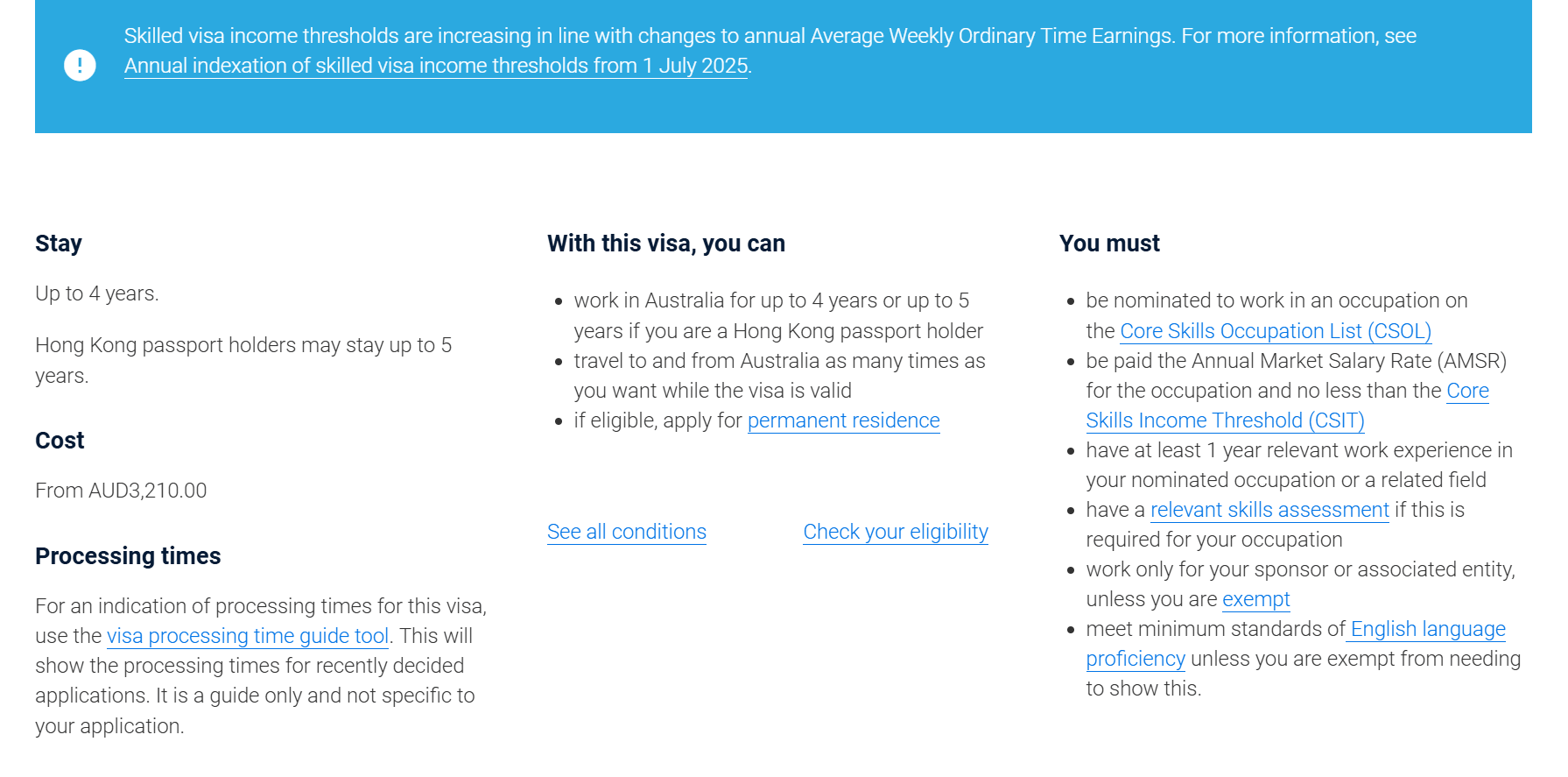
澳洲移民局 482 签证页面截图,介绍 SID 签证停留时间、费用、审理时间、CSOL职业清单、薪资门槛和申请条件

3. LMT Is One of the Steps Employers Most Commonly Overlook

The Department of Home Affairs makes it clear that before lodging certain nominations, employers may need to complete Labour Market Testing (LMT).

In simple terms, this means advertising the position in the Australian labour market and demonstrating that the recruitment process has been properly conducted.

Applications commonly run into problems because:

  • job advertisements were not published for long enough
  • the advertisement did not contain sufficient information about the genuine position
  • the advertising channels did not meet the requirements
  • screenshots, publication dates or recruitment records were not retained
  • the business simply says it “could not find anyone” without supporting evidence

This is particularly common among small and medium-sized businesses.

A business owner may genuinely have difficulty recruiting suitable workers, but a visa application requires evidence that can be submitted and verified.

This is why some employers initially believe sponsorship will be straightforward, only to discover later that the required evidence trail is incomplete.

4. Salary Is More Than Simply Agreeing on a Number

Another common misunderstanding is:

If the employer is willing to pay me, the position can be nominated.

In reality, a 482 / SID nomination must also meet the relevant salary requirements.

The Department generally requires the nominated salary to reflect the appropriate market salary and satisfy the relevant income threshold. Different streams may have different thresholds, and these amounts can change over time.

Common employer-side issues include:

  • the offered salary is below the applicable requirement
  • only a total remuneration package is stated, with no clear breakdown
  • the employer cannot provide evidence supporting the market salary
  • the proposed salary does not appear consistent with the responsibilities of the role

So after receiving an offer, the first reaction should not simply be:

Great, now I can apply.

The more useful question is whether the salary actually meets the 482 / SID nomination salary requirements.

Employer sponsorship meeting for a Subclass 482 visa application in Australia

5. Why Do Some Strong Applicants Still Get Stuck?

Because a subclass 482 visa is not assessed solely on the applicant.

It is an application involving three key elements:

the applicant + the employer + the nominated position

Even if the applicant satisfies the English, experience and qualification requirements, employer-side problems can still prevent the application from progressing smoothly.

Common examples include:

  • the business does not understand the sponsorship process
  • the position description is too vague
  • the job duties do not align with the applicant’s background
  • recruitment evidence is incomplete
  • salary evidence is insufficient
  • business compliance or operating documents are not properly prepared

This is why some applicants ask:

“I meet all the requirements, so why can’t I apply?”

In many cases, the problem is not the applicant. It is the employer side of the application.

The Department’s employer sponsorship guidance similarly treats nomination, salary, LMT and occupation requirements as key parts of the process.

6. What Should Applicants in Sydney and Melbourne Check First?

If you are currently looking for work in Sydney or Melbourne, or have already received an offer, the four things worth checking first are:

  1. Can this position actually be sponsored under the 482 / SID visa?
  2. Is the occupation included on the relevant list?
  3. Does the salary meet the applicable requirements?
  4. Is the employer willing and able to provide the required nomination documents?

There may be many employment opportunities in Sydney and Melbourne, but having a job opportunity does not automatically mean the role is suitable for sponsorship.

When an offer cannot ultimately be used for a 482 visa, the problem often comes down to employer-side details rather than the applicant’s own qualifications.

If the situation is more complicated, for example:

  • the occupation classification is unclear
  • the employer has never sponsored a worker before
  • the salary is close to the required threshold
  • the business does not know how to complete LMT
  • you also want to assess whether the visa could later lead to subclass 186 permanent residency

then it is generally more useful to assess the position, salary, occupation and employer circumstances together rather than guessing based on the visa name alone.

7. What Happens If the Employer-Side Documents Are Not Ready?

There are usually three direct consequences.

1) Application Delays

Incomplete documents often mean requests for further information, repeated clarification and internal back-and-forth between the applicant and employer, which can significantly slow down the process.

2) Increased Application Risk

If the position, salary, recruitment records and company documents are inconsistent with one another, the risk of problems during assessment can increase.

3) Wasted Time for the Applicant

Some applicants begin preparing English tests, health examinations, police clearances or even resignation arrangements before discovering that the employer is unable to complete the sponsorship process.

In many cases, this can create a much greater loss of time and effort.

8. A Practical Tip for Employers and Applicants

If you are the applicant, do not simply ask your employer:

“Can you sponsor me?”

More useful questions include:

  • Have you sponsored overseas workers before?
  • Which occupation will this position be nominated under?
  • How will the salary be determined?
  • Has LMT already been completed?
  • Who in the company will provide documents if further information is requested?

If you are the employer, the most efficient approach is also not to immediately start preparing a long document checklist.

First confirm the key issues:

  • position
  • occupation
  • salary
  • recruitment records
  • the business’s ability to cooperate with the process

If these points are assessed correctly at the beginning, the later stages are usually much easier to manage.

Summary

When applying for a subclass 482 visa, the employer needs to do far more than simply provide a job opportunity.

From occupation eligibility, position nomination and LMT to salary requirements, business documents and later requests for information, every stage can affect whether the application proceeds smoothly.

This is why many applicants encounter difficulties at the employer stage. The issue is not necessarily that the visa rules are unusually complicated, but that the employer-side preparation is often more detailed and easier to overlook than expected.

If you are currently assessing a job offer in Sydney or Melbourne, or are unsure whether your employer meets the relevant requirements, it is worth reviewing both the position and the business circumstances before deciding how to proceed.

Australia Visa Link can assist applicants with occupation matching, employer eligibility, salary requirements, LMT preparation and longer-term Employer Nomination Scheme 186(186签证) planning. If you are unsure whether your current offer may be suitable for a 482 / SID visa, or whether it may later provide a pathway to subclass 186 permanent residency, you are welcome to contact Australia Visa Link for an assessment.

Categories
新闻资讯-澳洲移民_en

Australia’s Final 189 Skilled Migration Invitation Round for 2025–26: Which Occupations Were Invited and How High Were the Scores?

The final Skilled Independent Visa 189(澳洲189技术移民) invitation round for this financial year has now been released. As soon as the data came out, many applicants had the same questions: Was my occupation invited? Were the scores high? Is it still worth waiting for a subclass 189 invitation?

The short answer is that quite a few occupations received invitations, but this was not a round of “easy low-score invitations”. Looking at the data, nursing, healthcare, education, social work, construction trades, surveying, architecture and food technology all performed relatively well. At the same time, scores remained high across many occupations, with 80 points becoming increasingly common and some occupations reaching 85 or even 90 points.

If you are following Australian Immigration(澳洲移民), this round of subclass 189 invitation data is worth looking at carefully. It is not only about who received an invitation. It also provides useful clues about the broader direction of skilled migration in Australia.

Australia 189 skilled migration occupations and invitation scores for the final 2025–26 round Summary of selected occupations and invitation scores from the final subclass 189 invitation round of the 2025–26 financial year

Which Occupations Stood Out in This 189 Invitation Round?

Healthcare-related occupations remained particularly strong in this round.

Social Worker received invitations at 80 points. Registered Nurse was invited at 80 points. Physiotherapist appeared at 80/85 points, Occupational Therapist at 80 points, Speech Pathologist at 80 points, Midwife at 80 points, Psychologist at 80 points, Psychiatrist at 80 points and Medical Laboratory Scientist at 80 points.

This shows that healthcare and allied health occupations continue to play an important role in subclass 189 invitation rounds. Australia has long had demand for healthcare, nursing and allied health professionals, and this has been reflected across multiple invitation rounds.

Education occupations also continued to appear. Secondary School Teacher received invitations at 80/85 points. These are not particularly low scores, but the fact that teaching occupations continue to appear in subclass 189 rounds suggests that they still have a degree of competitiveness.

Trades and Construction-Related Occupations Are Still Worth Watching

Carpenter was invited at 65/70 points, making it one of the more noticeable lower-score occupations in this round.

Architect appeared at 90 points, Construction Project Manager at 85 points, Surveyor at 80 points, Valuer at 85 points and Land Economist at 80 points.

This broadly reflects Australia’s current labour market needs. Housing, infrastructure, engineering projects, land development and property assessment all rely on skilled professionals and tradespeople.

Jobs and Skills Australia’s occupation shortage data also shows that skill shortages continue to vary across industries and regions, with both trades and professional occupations remaining important areas to watch.

So if your background is in construction, surveying, engineering management or a trade occupation, it is not enough to focus only on one invitation score. You should also consider whether your Skills Assessment(职业评估), work experience, English ability, EOI score and long-term migration pathway are all aligned.

Carpenter working on a construction project, representing trade occupations invited in Australia’s subclass 189 skilled migration program

Subclass 189 skilled migration applicant travelling while planning an Australian visa pathway

Less Common Occupations Still Have Opportunities, but Waiting Alone Is Risky

This round also included some occupations that are not always at the centre of migration discussions, such as Statistician at 90 points, Food Technologist at 90 points, Management Consultant at 85 points, and Lawyer / Solicitor at 80/85 points.

The fact that these occupations received invitations shows that subclass 189 is not limited to nursing and teaching.

However, the reality is that the scores are not low, and invitation frequency, competition levels and the number of EOIs in the pool vary significantly between occupations.

If your occupation is relatively niche or has not received invitations for a long time, it may not be wise to simply “keep waiting”. It can be useful to assess state nomination, employer sponsorship, regional migration pathways or other longer-term options at the same time.

Subclass 189 Is Not the Only Option

Many applicants become anxious when they see a new subclass 189 invitation round:

Someone else was invited at 80 points. What about me?

My occupation did not appear. Does that mean I have no chance?

Not necessarily.

Subclass 189 is an independent skilled migration visa. Its main advantage is that it does not require state nomination or employer sponsorship, and once granted, it offers a high degree of flexibility in where you live and work.

But that also means competition is more direct.

The Department of Home Affairs SkillSelect Invitation Rounds page continues to publish relevant invitation information. Rather than relying only on screenshots shared on social media, applicants should compare official invitation data with their own EOI Situation(EOI情况).

In addition, based on the 2026–27 migration planning levels, the Skilled stream remains an important part of Australia’s migration program, while planning levels for employer-sponsored migration have also increased significantly.

For applicants who are already working in Australia or who have a stable employer opportunity, employer sponsorship should not be overlooked.

Partner Visa, Employer Sponsorship or State Nomination: It Is Not Always About Which Is Better

One of the biggest mistakes in Australian migration planning is focusing on only one pathway.

Some applicants may still be well suited to continuing with subclass 189.

Others may be better positioned for state nomination.

For applicants with employer support, Employer Sponsorship(雇主担保) may be more realistic.

For others, family circumstances, relationships and long-term plans may mean that an Australian Partner Visa(澳洲配偶签证) is a more suitable pathway.

So instead of asking only:

“Can I get a subclass 189 visa?”

It may be more useful to ask:

  • Has my occupation received invitations recently?
  • Is my score competitive within my occupation?
  • Do I have relevant work experience or a realistic employer opportunity?
  • Should I prepare for subclass 190, subclass 491 or employer sponsorship at the same time?
  • Could my family circumstances also affect my visa options?

There is no single standard answer to these questions.

Skills assessment results, EOI scores, English test results, work experience and visa expiry dates differ from person to person, so migration strategies can also look very different.

What This Invitation Round Tells Applicants

The message from this subclass 189 invitation round is fairly clear: opportunities still exist, but waiting indefinitely is not the right strategy for everyone.

Healthcare, nursing, education, social work, construction trades, surveying and some professional occupations continue to receive invitations. At the same time, many occupations are now seeing scores of 80, 85 or 90 points, which shows that competition remains strong.

If your occupation appeared in this round, it may be a good time to review your EOI, points breakdown, English results and skills assessment validity before the new financial year.

If your occupation did not appear, there is no need to give up immediately. Instead, it may be time to consider whether other pathways can be prepared in parallel, such as the Skilled Nominated Visa 190(190签证), subclass 491 regional state nomination or employer sponsorship.

Australian migration planning is not just about looking at one invitation table. Your occupation, points score, visa timeline, employment opportunities and family circumstances should all be considered together.

If you are unsure whether you should continue waiting for subclass 189 or shift towards state nomination, employer sponsorship or another pathway, you are welcome to contact Australia Visa Link.

We can help you assess which migration strategy may be more suitable for your circumstances and whether you may benefit from working with an Australian Migration Agent(澳洲移民中介) for more detailed planning.

Categories
新闻资讯-澳洲移民_en

2026 Australian Immigration Points Test Reform: What Could Change?

Australia’s skilled migration points system has once again become a major focus of migration reform, and this is not expected to be a minor adjustment.

According to official consultation documents, Australia has used a points test to select skilled migrants since 1979, while the last major overhaul took place in 2012. If the current reform proceeds in line with the direction outlined in the 2026–27 Budget, it could represent the most significant reshaping of Australia’s skilled migration points system in almost 14 years.

For applicants, the real issue is not simply whether one factor will lose 5 points or another will gain 10. The more important question is what type of migrant the Australian Government wants the new points system to prioritise.

In simple terms, the future system is likely to place greater emphasis on applicants who are highly educated, highly skilled, younger, genuinely employable and capable of making a long-term contribution to Australia’s labour market.

Why Is Australia Changing the Skilled Migration Points Test?

One of the main criticisms of the current points system is that it can sometimes reward applicants who are good at accumulating points rather than those who are most likely to secure suitable employment in Australia.

For example, some applicants may increase their points through regional study, a Professional Year, community language credentials or partner points, but still struggle to find stable employment in their nominated occupation after graduation.

According to the Australian Government 2026–27 Budget, the permanent skilled migration points test is set for reform, with a stronger focus on selecting migrants who are better educated, more highly skilled and younger.

The government will also invest A$85.2 million to accelerate skills assessments for trades and improve the recognition of occupational licences.

This suggests that the reform is not a minor policy adjustment. It goes directly to the core of Australia’s skilled migration program.

The Reform Is Not About Abolishing Points but Changing Their Weight

Age Will Still Matter, but the System May Become More Refined

The current age points system contains several sharp cut-offs. For example, there can be a significant points difference between an applicant aged 39 and one aged 40, even though their potential contribution to the labour market does not suddenly change overnight.

Future reforms may introduce a more refined approach to age, placing greater emphasis on applicants who are likely to work in Australia for longer, pay tax for longer and have a longer career ahead of them.

This could be positive for applicants aged around 25 to 32. However, it also means that applicants approaching important age thresholds should not simply leave an EOI active indefinitely and hope for an invitation.

Before applying, it is worth checking the current Australian Skilled Migration EOI Points Calculator(澳洲技术移民EOI打分表) to understand how many points you currently receive for age, English, qualifications, work experience and partner factors, and then decide whether your strategy needs to be adjusted sooner rather than later.

Australian migration consultants helping clients plan their Australian PR pathway

Qualifications Still Matter, but a Degree Alone May Not Be Enough

Higher education is still likely to remain important, particularly for applicants with master’s degrees, PhDs, qualifications in areas of skills shortage and strong educational backgrounds.

However, the direction of reform is not about encouraging applicants to simply obtain more qualifications.

The more important issue is whether those qualifications align with Australia’s labour market needs.

In other words, what you study, whether you can obtain a suitable skills assessment and whether you can enter the relevant industry after graduation may become more important than simply having an Australian qualification.

Employment and Income Signals May Become More Important

The 2026–27 Budget makes it clear that the government wants the points system to select better educated, higher-skilled and younger migrants.

Here, “higher-skilled” should not be understood as qualifications alone. It can also involve genuine work experience, occupational alignment, English ability and the capacity to secure employment in Australia.

This is particularly important for applicants who are already working in Australia.

If you currently hold a subclass 485 visa, an Australian Student Visa(澳洲学生签证), are considering an employer-sponsored pathway or are looking at a Subclass 482 Visa(482签证), your future planning should not focus only on collecting points.

The more important question is whether you can demonstrate that you have the skills and employment profile Australia actually needs.

Which Applicants May Be Better Positioned Under the New System?

Applicant Type Areas Worth Strengthening Under the Reform
International students Course selection, skills assessment, internships and transition into graduate employment
Subclass 485 visa holders English, work experience, EOI timing and employer sponsorship opportunities
State-nominated applicants Local employment, residence commitments and whether the occupation matches state demand
Trades applicants Skills assessment, licensing recognition, genuine employers and industry experience
Families relying on partner points Partner English, qualifications, skills assessment and employability

The important point is that applicants may no longer be able to follow the same generic “points accumulation” strategy.

Before deciding on a pathway, applicants should identify whether their strongest advantages are in qualifications, age, occupation, English, work experience or employer connections and then build their migration strategy around those strengths.

Australian immigration consultation about skilled migration, EOI points and PR pathways

How Should You Choose Between the 190, 189, 491 and Employer-Sponsored Pathways?

If your occupation is in demand in a particular state and you have advantages such as local study, employment or residence, the Skilled Nominated Visa 190(190签证) is still worth serious consideration.

However, the 190 visa should not be viewed as a “lower-score version” of the subclass 189 visa. State and territory governments select applicants according to their own labour market needs, so occupational alignment and connections to the nominating state can be important.

If you have a high points score, work in a high-demand occupation and have strong English and work experience, subclass 189 remains the most direct independent skilled migration pathway.

Recent invitation patterns have generally placed greater emphasis on high-demand occupations such as healthcare, education, engineering and social work.

If your points are less competitive but you have a genuine employer willing to sponsor you, employer sponsorship may be a more realistic pathway.

Particularly as government policy continues to focus on employer-sponsored migration and genuine skills shortages, skilled migration and employer sponsorship should not always be assessed separately. In many cases, it makes more sense to evaluate both pathways at the same time.

What Should Applicants Avoid Doing Right Now?

First, avoid changing courses or occupations simply to chase a particular points category.

The final reform has not yet been implemented, so the more practical approach is to choose a pathway where you can complete a skills assessment, find genuine employment and explain a coherent career progression.

Second, do not rely entirely on unofficial “new points tables” circulating online.

The government has not yet published the final revised points table, nor has it confirmed exactly how every points category will change.

Claims on articles or short-form videos that a particular category “will definitely be removed” or that a specific group “will definitely benefit” should therefore be treated cautiously.

Third, do not wait until the new policy is implemented before preparing.

English test results, skills assessments, work experience, state nomination documents and employer opportunities cannot usually be prepared within one or two weeks.

What Should Applicants Do Now?

The most practical approach is to conduct a full pathway assessment.

Ask yourself:

How long do you have before reaching an important age threshold?

Can you obtain a suitable skills assessment?

Can you improve your English to a higher points band?

Is your current employment related to your nominated occupation?

Do you have realistic state nomination or employer sponsorship opportunities?

Can your partner contribute through English, qualifications or skilled employment?

If you are studying or working in Sydney, or are unsure whether you should pursue subclass 189, 190, 491 or employer sponsorship, working with a Sydney Migration Agent(悉尼移民中介) who understands both migration policy and the local employment market may provide more value than simply checking points tables.

Australian PR Planning Needs to Start Earlier in the New Points Era

The core of this points-test reform is not to make Australian PR completely unpredictable.

Instead, the selection logic appears to be shifting from simply asking “who has the most points?” towards “who is most likely to succeed in Australia over the long term?”

For applicants, the key is to connect qualifications, occupation, English ability, work experience and visa strategy into one clear pathway as early as possible.

If you are preparing for Australian Immigration(澳洲移民) but are unsure whether skilled migration, state nomination or employer sponsorship is the best option for your circumstances, you can contact Australia Visa Link for a more personalised pathway assessment.

Categories
新闻资讯-澳洲移民_en

Australia Immigration Reform 2026: Major Changes to Student Visas, Skilled Migration, WHV and More

Australia has announced a new round of migration reforms covering international students, graduate visas, visitor visas, skilled migration, Working Holiday visas and immigration compliance.

For temporary visa holders currently studying in Australia(澳洲留学)or working here, as well as people considering Australia through study, skilled migration or employer sponsorship, these changes are worth understanding early.

On 17 September 2026, Minister for Home Affairs Tony Burke outlined the reforms in a National Press Club address under three broad themes: who arrives, who stays and who leaves. The government said the measures are intended to give it greater control over temporary migration, target skills Australia needs and reduce Net Overseas Migration in line with Budget forecasts.

However, not every announcement is already operating as a completed visa rule.

Some measures have already taken effect, including the new skilled visa processing priorities introduced on 19 September. Others, including parts of the student, visitor, Working Holiday and points-test reforms, still require implementation details or further administrative changes.

For applicants, the distinction between an announced reform and a rule already in force is particularly important.

What Is Driving Australia’s 2026 Migration Reform?

The government’s latest migration strategy focuses on several interconnected issues:

  • reducing repeated visa switching used primarily to extend a temporary stay
  • tightening the integrity of international student pathways
  • directing skilled migration towards sectors facing labour shortages
  • gaining more control over demand-driven temporary migration
  • strengthening compliance for people who no longer hold valid visas
  • bringing Net Overseas Migration down towards Budget forecasts

The government says migration remains important to both Australia’s cities and regional economies, but argues that the system needs to be better targeted and more manageable.

For visa applicants, the practical message is becoming clearer:

A coherent study, career and visa pathway matters more than simply finding the next temporary visa available.

1. Student Visa Changes: A Stronger Crackdown on Visa Hopping

Student visas are one of the main areas affected by the announced reforms.

The government is targeting what it describes as visa hopping, where a person repeatedly moves between courses or visas primarily to remain in Australia rather than for a genuine educational or skilled migration purpose.

Importantly, the Minister also made clear that moving from one visa to another is not automatically considered visa hopping.

He specifically described a pathway from Student visa to Graduate visa, then to skilled employment, employer sponsorship and eventually permanent residence as an example of the migration system working as intended where the person genuinely develops skills Australia needs.

The concern is instead directed at repeated course changes or visa transitions without a credible education or career purpose.

Course Transfers May Require a New Student Visa

Under the announced reforms, students who transfer from one course to another would need to apply for a new Student visa so the Department can assess whether the change is genuine.

A legitimate transfer at the same qualification level may still be possible.

For example, a student who discovers that their current degree is not the right academic fit may have a genuine reason to transfer into another course.

The government has distinguished this type of transfer from repeated study undertaken mainly to extend a person’s stay.

Further Study Will Focus More Heavily on Qualification Progression

The more significant change concerns what happens after a qualification has been completed.

The government has announced a principle that students seeking another course after graduation should generally move up the qualification scale.

For example:

Bachelor degree → Master degree

would represent normal academic progression.

By contrast:

Master degree → unrelated lower-level vocational course

could become substantially harder to justify if the purpose appears to be extending a temporary stay rather than pursuing a genuine educational objective.

This does not mean that every lower-level course automatically results in a refusal.

The important issue is the overall study logic.

Applicants may increasingly need to explain:

  • why the new course is necessary
  • how it relates to previous qualifications
  • how it contributes to future employment
  • why the study plan is academically credible
  • whether the course fits the Genuine Student requirement

For people considering further study, course selection is therefore becoming both an education decision and a longer-term visa planning decision.

Applicants who may later consider an employer-sponsored pathway(雇主担保)should ideally think about study, occupation and employment as one connected pathway rather than three separate decisions.

2. Student and Graduate Visa Dependants: Family Rules Will Tighten

Family members of international students are another major part of the reform package.

The government has announced that it will generally stop international students and Temporary Graduate visa holders from attaching family members to their visas.

However, there will be exceptions.

The Minister specifically identified:

  • Pacific nationals
  • ASEAN nationals
  • certain types of study, including PhD programs

as groups for which special arrangements would remain.

The government also stated that families already in Australia with family members already attached to the relevant visa would not be separated under the new policy.

For families planning several years ahead, this means the primary student’s course may no longer be the only issue to consider.

A family study plan may also need to look at:

  • the partner’s own occupation
  • qualifications and English ability
  • employment opportunities
  • whether the partner could qualify for another visa independently
  • children’s education
  • household finances
  • the expected graduation date

For couples beginning a multi-year degree now, the rules in place at enrolment may not be the same rules that apply at graduation.

3. Visitor Visas: No Further Stay Conditions Set to Expand

Visitor visas are also part of the government’s attempt to reduce onshore visa switching.

The government announced that future Visitor visas will generally carry a No Further Stay condition, preventing visitors from routinely arriving on a temporary visit and then moving into another onshore visa pathway.

Protection claims are treated differently and cannot simply be prevented through a No Further Stay condition.

The change is intended to reinforce the basic purpose of a Visitor visa:

  • tourism
  • visiting family and friends
  • short-term visits

rather than using a Visitor visa as an entry point for an extended onshore stay.

This distinction is particularly relevant for applicants who:

  • intend to visit family in Australia
  • are considering another visa after arriving
  • have a partner in Australia
  • expect to extend their stay after entering as a visitor

It is also important to understand that these are different concepts:

visa validity ≠ permitted stay period ≠ visa conditions

A Visitor visa may remain valid for a particular period while still limiting how long a person can remain during each visit and what they can do while in Australia.

Applicants should therefore review the conditions attached to their individual visa rather than relying only on its expiry date.

International traveller reviewing visa documents amid Australia immigration changes in 2026

4. Skilled Visa Processing Priorities Have Changed Again

This is one area where the policy has already moved beyond the original announcement.

The 17 September speech initially referred to updating Ministerial Direction 119.

However, from 19 September 2026, Home Affairs introduced Ministerial Direction 121 and Ministerial Direction 122, which replaced all skilled visa processing priorities previously operating under MD119.

Ministerial Direction 121

MD121 applies to temporary skilled visas, including the Skills in Demand subclass 482.

Its highest processing priority applies to applications relating to:

  • Construction
  • Healthcare
  • Teaching
  • Agriculture
  • Aquaculture
  • Fishing
  • Resources
  • Australian law enforcement interests
  • Australian defence interests

The Specialist Skills stream of the 482 receives the next level of priority, followed by other applicants who were in Australia when they lodged their application.

Ministerial Direction 122

MD122 applies to specified provisional and permanent skilled visas, including:

  • subclass 186
  • subclass 189
  • subclass 190
  • subclass 191
  • subclass 491
  • subclass 494
  • several other skilled and regional visas

The same critical sectors receive first priority, followed by eligible applications lodged while the applicant was in Australia.

This means being onshore can still provide a processing advantage for many applicants, but it is no longer accurate to describe the current system simply as:

onshore applicants always come before offshore applicants.

Occupation, visa subclass and processing category all matter.

Most importantly:

processing priority does not mean priority approval.

It changes where an application sits in the processing queue. It does not remove requirements relating to:

  • occupation
  • English
  • points
  • skills assessment
  • nomination
  • employer sponsorship
  • health
  • character
  • other visa criteria

5. Australia Is Redesigning the Skilled Migration Points Test

The points-tested skilled migration system is also being redesigned.

The government says the objective is to increase the economic value of the permanent skilled migration program.

One particularly important proposal is the ability to give additional recognition to particular skills considered especially valuable to Australia.

The Minister specifically announced that, when the revised points test is implemented, workers skilled in housing construction trades are intended to receive qualification recognition equivalent to that currently associated with a university qualification for points purposes.

This could be relevant to applicants working in areas connected with:

  • building and construction
  • skilled trades
  • engineering
  • housing delivery

However, this is an important area where applicants should avoid getting ahead of the policy.

The new points framework has been announced, but applicants still need to wait for the final implementation rules to know:

  • exactly which occupations qualify
  • how many points will apply
  • whether other specialised skills receive uplifts
  • commencement dates
  • transitional arrangements

Until then, applicants should continue to assess eligibility under the rules currently in force.

6. Working Holiday Visa Changes: Ballots for Second and Third Years

The Working Holiday Maker program is also facing substantial changes.

The government has announced that second and third Working Holiday visas will move to a ballot system for participating arrangements where regional work requirements apply.

For the second year, applicants will still need to complete the existing qualifying regional work requirement of 88 days, but the ballot will be capped at 45,000 places.

For the third year, applicants will still need to meet the six-month regional work requirement, but only 5,000 places are planned under the ballot.

For context, around 57,000 people qualified for a second year and about 31,000 for a third year in the previous year, according to the Minister’s announcement.

The government has also said it intends to stabilise Working Holiday Maker processing times at around three months for relevant programs. The UK arrangement is being treated separately because its post-FTA rules do not use the same regional-work requirement.

For Working Holiday visa holders, completing the required regional work may therefore no longer guarantee access to another year.

It may instead qualify the applicant to enter the ballot.

That is a significant difference for anyone planning two or three years in Australia around a Working Holiday visa.

7. Stronger Enforcement Against Visa Overstayers

The government is also increasing its focus on people who remain in Australia after losing lawful visa status.

The announced measures include stronger compliance activity and increased resources for detention and removal.

ABC reported that the government plans to add 100 compliance officers and 250 detention beds as part of the enforcement expansion.

The government has also announced changes to the regulatory code applying to migration agents so that registered agents who encourage clients to make applications without merit can face sanctions or deregistration.

The stated objective is to reduce situations where people remain in Australia for extended periods through repeated applications or appeals that have little substantive basis.

At the same time, the Minister distinguished these cases from legitimate protection claims and said Australia would continue to maintain a genuine asylum system.

Why Is Australia Reforming Its Migration System Now?

Net Overseas Migration is a major part of the policy background.

The government reported that Net Overseas Migration had fallen to around 292,000, approximately 47% below the post-COVID peak.

It is now seeking to deliver Budget forecasts of:

  • 245,000 in the current financial year
  • 225,000 in 2027–28

and has said it will treat those forecasts as targets in light of housing pressures.

However, Net Overseas Migration and the Permanent Migration Program are not the same thing.

Net Overseas Migration

Net Overseas Migration measures the net population change resulting from people entering and leaving Australia over a given period under the relevant statistical definition.

It includes temporary as well as permanent movements.

Permanent Migration Program

The Permanent Migration Program is the government’s annual planning framework for permanent migration visas.

A lower NOM target therefore does not automatically mean that every visa category falls by the same percentage.

Nor does it mean that the Permanent Migration Program must decrease by exactly the same amount.

This distinction is particularly important when interpreting migration headlines.

What Do These Changes Mean for Visa Applicants?

The most useful question is not simply:

“Is Australia making immigration harder?”

The reforms affect different groups in different ways.

1. International Students Need a More Coherent Study Plan

Students may need to think more carefully about:

  • course progression
  • changing providers
  • qualification level
  • Genuine Student requirements
  • family arrangements
  • post-study employment

A course should make sense educationally, not simply provide another period of temporary stay.

2. Skilled Applicants Need to Separate Eligibility From Processing Priority

Working in construction, healthcare, teaching or another priority sector may improve where an eligible application sits in the processing queue.

It does not create eligibility by itself.

For example, a Skilled Nominated visa applicant still needs to satisfy the relevant points, occupation and nomination requirements.

3. Families Should Plan for More Than One Visa Scenario

Changes to Student and Graduate visa dependant arrangements make it increasingly important to consider whether both partners have independent options.

For families, the question is no longer only:

Which visa can the main applicant obtain?

It may also be:

What happens to the partner and children if dependant rules change?

4. Announced Policies and Current Rules Must Be Kept Separate

This is especially important following a major policy speech.

Some measures are already operating.

For example, MD121 and MD122 came into effect on 19 September.

Other measures remain announced reforms whose detailed commencement rules still need to be published.

Applicants should therefore avoid making major decisions based solely on social-media summaries or headlines.

Australia’s Migration System Is Moving Towards Earlier Planning

The overall direction of the reforms is not that Australia has stopped seeking international students or skilled workers.

The government continues to describe migration as economically important, while seeking tighter control over how temporary visas are used and which skills receive priority.

For applicants, that means greater emphasis on having a pathway that makes sense from beginning to end.

For an international student, that might mean:

course → qualification → graduate employment → skilled or employer-sponsored pathway

rather than repeatedly choosing another course when a visa approaches expiry.

For a skilled worker, it may mean assessing:

occupation → skills assessment → employer opportunity → nomination → permanent pathway

well before the current visa expires.

Whether you are considering studying in Australia, changing courses, skilled migration, employer sponsorship or family visa planning, early preparation provides more room to respond when policy settings change.

Australia Visa Link can review your education, occupation, visa history and longer-term objectives to help you assess a more suitable Australian migration(澳洲移民)pathway under the latest policy settings.

Information notice: This article reflects publicly available information as at 21 September 2026. Some reforms announced by the Australian Government on 17 September 2026 have not yet had all commencement dates, transitional arrangements or detailed implementation rules published. Ministerial Directions 121 and 122 took effect on 19 September 2026 and replaced the skilled visa processing priorities previously operating under Ministerial Direction 119. Always check the latest Department of Home Affairs requirements before making a visa application.

Categories
新闻资讯-澳洲留学_en

Study in Australia After Gaokao 2026: Direct Entry to the Group of Eight or Foundation?

Gaokao results are out, and for Chinese high school graduates, one exam result does not have to define the entire university journey.

In recent years, using Gaokao results to apply directly to overseas universities has become an increasingly practical option for students who want to keep both Chinese and international university pathways open.

Among the major study destinations, studying in Australia(澳洲留学)remains particularly attractive because Australian universities have relatively broad recognition of the Chinese Gaokao.

For students aiming high, Australia’s Group of Eight (Go8) universities are often at the top of the list.

The good news is that seven of the eight Go8 universities currently recognise Gaokao results for direct undergraduate entry into eligible courses. The University of Melbourne remains the major exception and does not currently accept Gaokao for direct undergraduate admission. Its preferred pathway for many Chinese high school students is through foundation studies such as Trinity College Foundation Studies.

So after Gaokao, the real question is no longer simply:

“Can I get into an Australian university?”

It is:

“Should I use my Gaokao score for direct entry, or would a foundation pathway give me a better university and course outcome?”

2026 Group of Eight Entry Requirements for Chinese Gaokao Students

Before comparing universities, it is important to understand one thing:

There is no single Gaokao cut-off for an entire Australian university.

Entry requirements vary by:

  • degree
  • faculty
  • course competitiveness
  • prerequisite subjects
  • English requirements
  • intake
  • the maximum Gaokao score in your province

For example, UNSW assesses Gaokao based on a percentage of the maximum score available in the relevant province, with its 2026 guide showing requirements ranging from around 70% to 90% depending on the course.

ANU also uses course-specific entrance ranks. For provinces where the Gaokao maximum is 750, published indicative requirements range from 525 for an entrance rank of 80 up to 690 for an entrance rank of 99.

Here is a more useful overview for 2026 planning:

University 2026 QS Ranking Gaokao Position Indicative Entry Level Popular Study Areas
UNSW Sydney #19 Accepts Gaokao Around 70%–90%, depending on course Engineering, Business, Computer Science, Architecture, Law, Science
University of Melbourne =#22 No direct Gaokao entry Foundation or another recognised qualification generally required Commerce, Biomedicine, Engineering pathways, Science, Design, Arts
University of Sydney #28 Accepts Gaokao Course-specific; Gaokao is a recognised Chinese qualification Business, Engineering, Computing, Architecture, Arts, Science, Health
Australian National University #29 Accepts Gaokao Approximately 525–690/750 depending on program International Relations, Economics, Computing, Science, Politics
Monash University #31 Accepts Gaokao for most eligible undergraduate courses Commonly from around 60% upward, with higher-demand courses requiring more Pharmacy, Business, Engineering, IT, Education, Nursing
University of Queensland =#40 Accepts Gaokao Course-specific, commonly based on percentage equivalents Engineering, Science, Business, Agriculture, Computing, Health
University of Western Australia =#77 Accepts Gaokao Approximately 65%–90% depending on required ATAR equivalent Engineering, Business, Data, Science, Health, Architecture
Adelaide University =#82 Accepts Gaokao Many programs start around 60%–65%, with higher requirements for some degrees Engineering, Business, IT, Science, Health, Architecture

UNSW, ANU, Monash and UWA all publish Gaokao-specific admission information, while Sydney recognises Gaokao as an accepted Chinese secondary qualification. Adelaide University’s 2026 international guide also lists Gaokao entry requirements by degree.

One important detail is that 750 is not the maximum Gaokao score in every province. Universities generally calculate requirements using the maximum score applicable to the student’s examination system, so students should not simply convert every percentage into a score out of 750.

What Should You Actually Compare in This Table?

Do not look only at the ranking.

There are four things that matter much more when building a realistic university shortlist.

First, check the requirement for the actual degree.

A university may accept 70% for one course but require substantially more for another.

Second, check subject prerequisites.

Engineering, science, computing and health courses may require Mathematics, Chemistry, Physics or Biology results in addition to the overall Gaokao score.

UQ, for example, publishes specific Gaokao subject equivalents for Mathematics, Chemistry, Physics and Biology prerequisites.

Third, meeting the academic score does not automatically satisfy the English requirement.

Students may still need IELTS, PTE, TOEFL or another accepted English qualification.

Fourth, compare tuition and living costs together.

Sydney and Melbourne can offer excellent academic and employment opportunities, but accommodation and day-to-day costs may be higher than in cities such as Adelaide or Perth.

The best university is therefore not necessarily the highest-ranked university you can technically enter.

It is the university where your:

score + course + English + budget + career plan

make sense together.

Two Main Pathways After Gaokao: Direct Entry vs Foundation

For most Chinese high school graduates, there are two main ways to begin an Australian undergraduate degree.

Pathway A: Direct Entry Using Your Gaokao Score

Direct entry means using your completed Gaokao result to apply directly for Year 1 of an Australian bachelor degree.

Who Is Direct Entry Best For?

It can work particularly well for students who:

  • already meet the Gaokao requirement for their target degree
  • have relatively strong English
  • are confident about their intended major
  • are academically ready for university-level study
  • want to reduce the overall time and cost before starting the degree

The biggest advantage is obvious.

If you qualify for direct entry, you can usually begin the bachelor degree immediately instead of completing an additional foundation year first.

For a standard three-year Australian bachelor degree, this may mean completing the university program in approximately three years rather than adding a separate preparation program beforehand.

But direct entry should not automatically be treated as the “better” option.

Direct Entry Means Starting Real University Work Immediately

Australian undergraduate study is quite different from Chinese high school.

From the first semester, students may need to handle:

  • lectures
  • tutorials
  • academic readings
  • essays and reports
  • group assignments
  • presentations
  • independent research
  • exams

A student may have a strong Gaokao score but still struggle if their academic English, writing or independent learning skills are not ready.

So the real question is not:

“Can I get direct entry?”

It is:

“Am I ready to succeed after direct entry?”

Saving one year is only valuable if the student can adapt successfully once the degree begins.

Pathway B: Foundation Studies

Foundation studies are designed to prepare international students for undergraduate study.

They may be particularly useful for students who:

  • do not meet the direct Gaokao requirement
  • did not perform as expected in the Gaokao
  • want to strengthen academic English
  • need additional preparation in key subjects
  • want time to adapt to the Australian education system
  • are specifically targeting a university that does not accept Gaokao direct entry

The University of Melbourne is the clearest example.

It states that it does not currently accept Gaokao results for direct entry, and Trinity College Foundation Studies is its preferred foundation pathway for many international students from China.

Foundation study is therefore not simply a “backup for students with low scores”.

It can also be a strategic pathway.

According to Studies in Australia’s guide to foundation courses, foundation programs are specifically designed to help international students develop the academic and English skills needed for undergraduate study.

Typical foundation subjects may include:

  • academic English
  • essay writing
  • research skills
  • mathematics
  • sciences
  • business subjects
  • discipline-specific preparation

This can make the transition into university significantly smoother.

Direct Entry or Foundation: Which One Should You Choose?

The answer depends on much more than whether your Gaokao score technically meets the minimum.

Choose Direct Entry If:

You already meet the academic requirements, have strong English and are confident about adapting quickly to Australian university study.

It can save both time and tuition.

Consider Foundation If:

Your score is below your preferred university’s direct-entry requirement, your English still needs development, or you want a structured transition before entering undergraduate study.

Foundation may also make more sense if it gives you access to the course and university you genuinely want, rather than forcing you into a less suitable degree simply because it offers immediate direct entry.

A student choosing between:

direct entry into a course they do not really want

and

foundation followed by a stronger target degree

should compare the final outcome, not just the extra year.

International university students on campus after choosing to study in Australia

How to Shortlist Australian Universities After Gaokao Results

Once the score is available, students can generally approach university selection in three broad groups.

1. Strong Gaokao Results: Build a Reach, Target and Safety Strategy

Students with strong results may be competitive for universities such as:

  • UNSW
  • University of Sydney
  • ANU

But applying only according to QS rankings is rarely a good strategy.

For example:

UNSW has particularly strong recognition in areas such as engineering, business and computing.

University of Sydney offers a very broad range across business, architecture, engineering, humanities, science and health.

ANU has distinctive strengths in areas including politics, international relations, Asia-Pacific studies, economics, research and science.

The better approach is to create three groups:

Reach universities
Courses where your score is competitive but admission is less certain.

Target universities
Courses where your academic profile aligns well with published requirements.

Safety options
Universities or courses where you have a stronger admissions margin.

This reduces the risk of putting every application into one highly competitive university or major.

2. Mid-Range Gaokao Results: Focus on Course Fit, Not Just University Rank

Students whose scores sit below the most competitive direct-entry requirements can still have very strong options at:

  • Monash University
  • University of Queensland
  • University of Western Australia
  • Adelaide University

Monash, for example, accepts Gaokao for most eligible undergraduate degrees, with its published 2026 requirements starting at around 60% for some courses and increasing for more competitive programs.

UWA’s published Gaokao equivalencies begin at approximately 65% for an ATAR-equivalent of 70, rising to around 90% for an ATAR-equivalent of 98.

Adelaide University also lists Gaokao entry requirements from around 60% for some degrees, with requirements increasing depending on the program.

This is where careful course planning becomes especially valuable.

Two students studying “IT”, for example, could end up in very different degrees focused on:

  • software development
  • data science
  • cybersecurity
  • artificial intelligence
  • information systems

Similarly, two business degrees may offer very different majors and career outcomes.

Students considering longer-term employment in Australia should therefore think about the relationship between:

degree → major → graduate skills → occupation → employment opportunities

rather than waiting until the final year of university to think about careers.

If you are unsure how your university choice may interact with longer-term study, visa and career planning, an Australian migration agent(澳洲移民中介)can help you consider these issues together rather than treating university admission as an isolated decision.

3. If the University of Melbourne Is the Goal, Plan the Foundation Pathway Properly

For some students, the goal is very specific:

The University of Melbourne.

Because the University of Melbourne does not currently accept Gaokao for direct undergraduate entry, students using the Chinese high school pathway will generally need to consider an alternative recognised qualification or a pathway such as Trinity College Foundation Studies.

But this does not mean:

complete foundation = automatically enter any Melbourne degree.

Students still need to satisfy the progression requirements for their intended undergraduate course.

This is why the target bachelor degree should be considered before beginning foundation.

For example, a student interested in:

  • Commerce
  • Science
  • Biomedicine
  • Design
  • Arts

may face different subject and progression requirements.

Before accepting a foundation offer, confirm:

  1. the intended undergraduate degree
  2. required foundation subjects
  3. progression score
  4. English requirement
  5. prerequisite subjects
  6. alternative options if the required progression score is not achieved

That is much safer than completing the foundation year first and only then deciding what degree to pursue.

How Much Does It Cost to Study in Australia After Gaokao?

Tuition varies significantly by university and degree.

As a broad guide, many Group of Eight undergraduate degrees for international students now sit around A$45,000 to A$60,000+ per year, while certain clinical, medical and specialist programs can cost substantially more.

For example, the University of Sydney lists 2026 undergraduate fees of around A$52,500 for architecture, design and planning, while arts and social sciences generally range from approximately A$49,200 to A$56,300.

Tuition should not be considered in isolation.

Families should also budget for:

  • accommodation
  • food
  • transport
  • Overseas Student Health Cover
  • textbooks and equipment
  • flights
  • visa costs
  • daily living expenses

A university with slightly lower tuition in a more affordable city may result in a significantly different total three-year cost.

That is why a realistic study plan should compare the whole degree budget, not only the first-year tuition fee.

What About Perth and Adelaide for Students Thinking Long Term?

Perth and Adelaide can be attractive because they combine major universities with a different cost and lifestyle profile from Sydney and Melbourne.

They are also classified as designated regional areas for Australian migration purposes under current regional migration settings.

However, students should be careful with the idea that studying in a regional area automatically guarantees migration advantages or a longer graduate visa.

Eligibility for any regional benefit or post-study arrangement depends on the visa rules applying at the relevant time and the student’s individual circumstances.

A city should therefore be selected first because it makes sense for:

  • the degree
  • employment opportunities
  • lifestyle
  • budget
  • professional development

Any migration benefit should be treated as an additional consideration rather than the sole reason for choosing a university.

A Practical Timeline After Gaokao Results

For students targeting the following February intake, the months after Gaokao results are important.

June to July: Shortlist Universities and Submit Applications

Prepare:

  • official Gaokao results
  • three-year high school transcript
  • graduation certificate
  • passport
  • supporting documents required by the university

At this stage, students should ideally build several options rather than applying to only one university.

Depending on the university and outstanding requirements, students may initially receive a conditional offer.

August to October: Complete English Requirements

Students who still need to meet the English requirement can prepare for an accepted test such as:

  • IELTS
  • PTE Academic
  • TOEFL

If the required result is achieved, the university can generally progress the admission process once all other conditions are satisfied.

Where appropriate, some students may also consider an approved English-language pathway before beginning the degree.

October to December: Finalise Enrolment and Student Visa Preparation

Once admission conditions are satisfied, students can accept the offer and complete the steps required to receive their Confirmation of Enrolment.

They can then prepare an Australian Student Visa subclass 500(澳洲学生签证)application.

Visa preparation may involve more than simply uploading an offer letter, so students should allow time for the required documents and Genuine Student assessment.

January to February: Prepare for Australia

Once the visa and enrolment arrangements are complete, attention shifts to:

  • accommodation
  • flights
  • enrolment
  • orientation
  • banking
  • transport
  • Overseas Student Health Cover
  • university systems
  • settling into life in Australia

For many students, this is the point where the Gaokao journey finally turns into a university journey.

What If You Miss the February Intake?

Missing February does not necessarily mean waiting an entire year.

Many Australian universities offer a mid-year intake for at least some undergraduate programs.

However, course availability varies.

Some degrees:

  • only commence once a year
  • have prerequisite sequencing
  • have limited mid-year places
  • may require a different study plan if starting in Semester 2

If your English results, documents or visa timing make February unrealistic, it can be better to consider the next suitable intake rather than rushing into an application with insufficient preparation.

Your Gaokao Score Is a Starting Point, Not the Final Decision

After Gaokao results are released, students often focus on one question:

“What is the highest-ranked university my score can get me into?”

A better question is:

“Which course and university combination gives me the strongest overall outcome?”

A high QS ranking can be valuable, but it does not tell you:

  • whether the degree fits your career goal
  • whether you will enjoy the city
  • whether your family can comfortably manage the cost
  • whether you are academically ready for direct entry
  • whether another pathway could lead to a better degree
  • what employment opportunities may look like after graduation

For some students, direct entry is clearly the most efficient choice.

For others, foundation provides the academic transition needed to reach a stronger long-term destination.

Neither pathway is automatically better.

The right choice depends on the student.

If you are considering studying in Australia(澳洲留学)after the 2026 Gaokao, Australia Visa can review your province, Gaokao score, English level, preferred course, budget and future plans to help you compare direct undergraduate entry and foundation pathways.

A Gaokao score may already be fixed, but how you use that score can still open very different doors.

Categories
新闻资讯-澳洲移民_en

Information notice: This article has been updSkilled Migration Points Too Competitive? 2026 Guide to Australian Employer-Sponsored Visa Pathways

For many people studying or working in Australia, as well as experienced professionals overseas, points-tested skilled migration is no longer the only pathway worth considering.

When planning Australian migration(澳洲移民), applicants increasingly compare employer sponsorship alongside independent skilled migration and state nomination rather than relying on a single pathway.

For some occupations, building a competitive EOI points score(EOI分数)can take time, while invitation rounds and state nomination settings can also change.

Australian employer sponsorship(澳洲雇主担保)works differently.

Instead of being driven primarily by a points score, employer-sponsored pathways focus more heavily on whether there is a genuine position, whether an Australian employer is prepared and eligible to sponsor the worker, whether the occupation matches the role, and whether the applicant has the required skills and experience.

The Department of Home Affairs describes the Skills in Demand subclass 482 visa as a pathway allowing an employer to sponsor a suitably skilled worker for a position where an appropriately skilled Australian worker cannot be found.

That does not mean that getting a job offer automatically leads to a visa.

A successful employer-sponsored application still depends on the employer, the position and the applicant all meeting the relevant requirements.

Main Australian Employer-Sponsored Visa Pathways in 2026

The main employer-sponsored pathways currently include the subclass 482, 186 and 494 visas, together with Labour Agreement and DAMA arrangements.

Visa Pathway Visa Type Main Feature Who It May Suit
482 Skills in Demand Temporary work visa Employer sponsors the applicant to work in a nominated skilled position Applicants with an eligible job and at least 12 months of relevant experience who want to work in Australia first
186 Employer Nomination Scheme Permanent visa Employer-nominated permanent residence through streams including Direct Entry and TRT More established workers who may qualify directly, or eligible sponsored workers progressing from a 482 pathway
494 Skilled Employer Sponsored Regional 5-year provisional regional visa Work for an employer in designated regional Australia with a potential pathway to permanent residence Applicants open to regional employment and who generally have at least 3 years of relevant experience
Labour Agreement / DAMA Agreement-based pathway Allows approved employers or designated regions to use negotiated migration arrangements Applicants whose occupation or circumstances fit a specific industry, employer or regional agreement

The Skills in Demand subclass 482 generally requires at least 12 months of work experience in the nominated occupation or a related field. The 186 Direct Entry stream generally requires at least 3 years of relevant work experience, unless an exemption applies. The 494 Employer Sponsored stream also generally requires at least 3 years of relevant experience.

The important point is that these are different pathways, not simply different versions of the same visa.

Pathway A: 482 Skills in Demand Visa — Work First, Then Plan the Next Step

The Skills in Demand visa subclass 482(482签证)is one of Australia’s main temporary employer-sponsored work visas.

It can suit applicants who have found an Australian employer and whose occupation, experience, salary and nominated position meet the relevant requirements.

Applicants generally need to be nominated by an approved sponsor, have the skills required for the position and satisfy the applicable English requirements. Home Affairs also states that applicants generally need at least 12 months of experience in the occupation or a related field.

Core Skills Stream

The Core Skills stream covers occupations on the Core Skills Occupation List.

This pathway may suit applicants working in mainstream professional and skilled occupations where there is a genuine position and the employer is able to meet the relevant sponsorship and nomination requirements.

Salary is now particularly important.

From 1 July 2026, the Core Skills Income Threshold increased to AUD 79,423. The nominated salary must also satisfy the relevant market salary requirements, so meeting the threshold alone does not necessarily make a position eligible.

In practice, employers therefore need to consider more than whether an occupation appears on a list.

The position itself, duties, salary and applicant’s background all need to fit together.

Specialist Skills Stream

The Specialist Skills stream is aimed at higher-paid skilled positions.

Under the current rules, it is available for eligible occupations in specified ANZSCO major groups where the nominated salary meets the Specialist Skills Income Threshold.

From 1 July 2026, that threshold is AUD 146,576.

This stream can be relevant to senior or highly specialised professionals, but a high salary by itself is not enough. The occupation, position and applicant still need to meet the stream’s requirements.

Labour Agreement Stream

The Labour Agreement stream applies where the employer has an approved labour agreement with the Australian Government.

Labour agreements can be used where there is a demonstrated workforce need that cannot be met through the standard skilled migration program. They may operate through industry agreements, company-specific agreements or Designated Area Migration Agreements, commonly known as DAMAs.

Some agreements can contain different arrangements for matters such as:

  • occupations
  • English requirements
  • age
  • salary
  • work experience

But these concessions are agreement-specific.

Applicants should not assume that a DAMA automatically means easier English, age or work experience requirements. The actual terms of the relevant agreement need to be checked.

Why Do Applicants Consider the 482?

The 482 pathway does not rely on an EOI points score and does not require a state nomination invitation.

Instead, its focus is on the employment relationship.

For the right applicant, it can provide a way to:

  • continue or begin skilled employment in Australia
  • build relevant Australian work experience
  • establish a longer-term relationship with an employer
  • later assess eligibility for permanent employer-sponsored options such as the 186 TRT stream

But a 482 is not simply a matter of finding an employer willing to sign paperwork.

The nominated role must be genuine, salary requirements must be met, the occupation needs to fit the position, and the applicant needs the skills and experience to perform the role.

Pathway B: 186 Employer Nomination Scheme — Can You Go Directly to Permanent Residence?

The Employer Nomination Scheme subclass 186(186签证)is particularly attractive because it is a permanent visa.

Two of the most relevant pathways for many applicants are Direct Entry and Temporary Residence Transition.

1. Direct Entry: Applying Directly for the 186

The Direct Entry stream can suit applicants with a more established professional background.

Under the current requirements, most applicants need:

  • an eligible occupation
  • at least 3 years of relevant work experience
  • a positive skills assessment, unless exempt
  • the required level of English
  • an approved employer nomination
  • to generally be under 45, unless an exemption applies

This can make Direct Entry particularly relevant to experienced professionals who do not necessarily need to spend several years on a 482 before becoming eligible for permanent residence.

Its advantages can include:

  • permanent residence from visa grant
  • no requirement to first spend years accumulating points
  • no state nomination invitation process
  • a potential direct route for applicants whose experience and employer arrangement are already mature

However, it also tends to require stronger evidence upfront.

Work experience, skills assessment, employment history, employer nomination and the nominated role all need to withstand scrutiny.

2. Temporary Residence Transition: Moving From 482 to 186

For many people already working in Australia, the 186 Temporary Residence Transition stream may be the more practical route.

Under the current rules, applicants generally need to have completed at least 2 years of eligible sponsored full-time employment in Australia during the 3 years immediately before applying, while holding an eligible 457, 482 or related bridging visa. They also need an approved nomination from an Australian employer.

This makes the pathway relevant to people who:

  • already have an employer willing to sponsor them
  • are working in a stable skilled position
  • want to move from temporary sponsored employment toward permanent residence
  • may not have a sufficiently competitive points score for 189 or 190
  • are already building eligible sponsored employment on a 482 visa

Importantly, working for two years does not automatically convert a 482 into permanent residence.

At the time of the 186 application, the applicant and employer must still satisfy the applicable nomination and visa criteria.

Employment records, salary, visa history and the nominated position can all remain relevant.

Employer and skilled worker discussing Australian employer sponsored visa pathways

Pathway C: 494 Regional Employer Sponsorship — Looking Beyond Sydney, Melbourne and Brisbane

The Skilled Employer Sponsored Regional subclass 494(494签证)is designed for applicants sponsored by employers in designated regional areas.

One important point is that “regional Australia” does not necessarily mean a small remote town.

For migration purposes, designated regional areas cover all of Australia except Sydney, Melbourne and Brisbane.

That means many substantial Australian cities and regional centres can fall within the regional migration framework.

The 494 Employer Sponsored stream generally:

  • is granted for 5 years
  • requires the applicant to live, work and study in designated regional Australia
  • requires at least 3 years of relevant work experience, unless an exemption applies
  • generally requires a relevant skills assessment
  • requires an eligible regional employer nomination

Eligible holders may be able to apply for the subclass 191 permanent visa after holding the relevant regional visa for at least 3 years and satisfying the applicable requirements.

This route may be relevant to applicants who:

  • have strong work experience but are less competitive in points-tested migration
  • are willing to build a career outside Sydney, Melbourne and Brisbane
  • can secure genuine employment with a regional employer
  • work in industries where regional labour demand is stronger

Regional opportunities can be particularly relevant in sectors such as healthcare, trades, engineering, agriculture and hospitality, although the correct visa pathway still depends on the actual occupation and position.

Who May Be Better Suited to Employer Sponsorship?

Employer sponsorship is not inherently “better” than skilled migration.

The more useful question is whether it matches the applicant’s actual circumstances.

Applicants With Strong Work Experience but a Less Competitive Points Profile

Someone may have substantial professional experience but not score particularly strongly under a points-tested visa.

If that person has a genuine employer willing and eligible to sponsor them, an employer-sponsored route may operate very differently from continuing to pursue higher EOI points.

That does not remove visa requirements, but it changes what the application is primarily based on.

Graduates Already Working for Australian Employers

Some Temporary Graduate visa holders are already working in professional positions in Australia.

If their occupation, role, salary, experience and employer all align with an employer-sponsored visa, it can be useful to assess the pathway before the 485 visa approaches expiry.

Waiting until the final few months can reduce the amount of time available to address issues such as:

  • insufficient experience
  • salary adjustments
  • employer sponsorship eligibility
  • occupation mismatch
  • skills assessments
  • missing work evidence

Experienced Overseas Professionals

Employer sponsorship is not limited to people already living in Australia.

Experienced professionals overseas may also be sponsored by Australian employers where the position and applicant satisfy the relevant requirements.

For some applicants, this means the first Australian visa in their migration strategy could be a 482, 186 Direct Entry or 494 rather than a Student or Graduate visa.

Applicants Open to Regional Australia

Applicants who are flexible about location may have a broader range of employer opportunities.

A regional strategy can involve a 494 visa or, where applicable, a DAMA arrangement.

However, moving regional simply for migration purposes is not enough. There still needs to be a genuine job, an eligible employer and a visa pathway that matches the applicant’s background.

Where Do Employer-Sponsored Applications Commonly Run Into Problems?

1. An Employer Saying “Yes” Is Only the Beginning

An employer’s willingness to sponsor is important, but it is not the same as being eligible to sponsor successfully.

Depending on the visa, the employer may need to satisfy sponsorship and nomination requirements, demonstrate that the position is genuine, meet salary requirements and provide appropriate business evidence.

2. Salary Is Now a Major Eligibility Issue

Employer-sponsored visas are not assessed simply by job title.

From 1 July 2026, the Core Skills Income Threshold and Temporary Skilled Migration Income Threshold are AUD 79,423, while the Specialist Skills Income Threshold is AUD 146,576.

The actual salary requirements can also involve the market salary rate for the position.

So an employer cannot simply nominate an occupation from the relevant list and choose an arbitrary salary.

3. Job Duties Need to Match the Occupation

Occupation titles can be misleading.

Someone may have “Manager” in their title but primarily perform administrative or frontline duties.

Likewise, someone called a “Developer” may not actually perform enough core software development tasks for the nominated occupation to make sense.

The nominated occupation should be supported by the actual:

  • duties
  • employment contract
  • organisational structure
  • salary
  • work records
  • business activities

A title alone does not establish that a position is appropriate.

4. Work Experience Evidence Should Be Prepared Early

Depending on the visa and occupation, evidence may include:

  • employer reference letters
  • employment contracts
  • payslips
  • tax records
  • position descriptions
  • organisation charts
  • project evidence
  • professional registration
  • skills assessment documents

This becomes particularly important for pathways such as 186 Direct Entry and 494, where experience and skills assessment requirements can be substantial.

Waiting until a current visa is close to expiry can make missing evidence much harder to fix.

A Practical Australian Employer Sponsorship Timeline

Rather than treating sponsorship as a single visa application, it is better understood as a sequence involving both the employer and the worker.

Step 1: Assess the Applicant and the Employer

Start by checking the applicant’s:

  • occupation
  • qualifications
  • relevant work experience
  • English level
  • current visa
  • age
  • intended location
  • long-term objective

At the same time, review whether the employer and position are suitable for sponsorship.

This includes questions such as:

  • Is the business actively operating?
  • Is there a genuine need for the position?
  • Does the occupation match the actual duties?
  • Is the salary compliant?
  • Is the employer prepared to complete the sponsorship process?

Step 2: Choose the Most Appropriate Pathway

If the immediate goal is to continue working in Australia, a 482 may be relevant.

If the applicant already has substantial experience, an eligible occupation, skills assessment and employer support, 186 Direct Entry may be worth assessing.

If the position is in regional Australia, the 494 may also need to be compared.

For applicants whose occupation or circumstances do not fit the standard programs, a Labour Agreement or DAMA may sometimes be relevant.

The pathway should follow the facts of the case rather than the other way around.

Step 3: Prepare the Employer Side

Employer-sponsored migration normally involves substantial employer documentation.

This can include:

  • sponsorship information
  • nomination documents
  • position descriptions
  • salary information
  • business operating evidence
  • employment contracts
  • recruitment evidence

Labour Market Testing may also apply.

Home Affairs states that where required, labour market testing generally involves advertising the Australian position for at least four weeks in at least two advertisements, subject to applicable exemptions.

This is designed to demonstrate that the employer has genuinely tested the Australian labour market before recruiting an overseas worker.

Step 4: Prepare the Applicant’s Evidence

Applicant documents may include:

  • passport and identity documents
  • English test results
  • qualifications
  • employment evidence
  • skills assessment where required
  • CV
  • police certificates
  • health examinations
  • professional registration or licensing

The exact requirements depend on the visa and occupation.

Healthcare, teaching, engineering and trade occupations, for example, can involve additional professional or skills assessment requirements.

Step 5: Lodge the Nomination and Visa Application

Employer sponsorship is not just an individual visa application.

The employer-side nomination and the worker’s visa application need to support the same story.

A genuine position cannot compensate for an applicant who does not meet the visa criteria, and a strong applicant cannot compensate for a nomination that does not meet the employer requirements.

Processing priority can also vary according to the occupation, visa subclass and where the applicant was located when the application was lodged.

Since 19 September 2026, temporary skilled applications such as the 482 are prioritised under Ministerial Direction 121, while the 186, 494 and several other provisional and permanent skilled visas are prioritised under Ministerial Direction 122. Priority sectors currently include construction, healthcare, teaching, agriculture, aquaculture, fishing and resources, as well as specified law enforcement and defence interests. Eligible onshore applications also receive priority over certain offshore categories.

Applicants considering the 482, 186 or 494 can read more about Australia’s current skilled visa processing priorities and the onshore lodgement position(澳洲技术签证审理优先级与雇主担保境内递交优势).

However, processing priority only affects when an application is considered. It does not reduce the requirements relating to the position, work experience, English, salary or nomination.

Step 6: Keep Planning After the Visa Is Granted

A 482 grant is not the end of the migration strategy.

Visa holders should continue monitoring:

  • visa conditions
  • employer changes
  • occupation changes
  • salary changes
  • eligible sponsored employment
  • potential 186 TRT timing
  • alternative permanent visa options

If permanent residence is the longer-term objective, it is usually better to understand the possible transition requirements early rather than waiting until the temporary visa is about to expire.

482 vs 186 vs 494: The Key Question Is Not Which Visa Is “Best”

There is no single employer-sponsored visa that suits every applicant.

A person with one year of relevant experience and a supportive employer may be looking at a very different pathway from someone with five years of overseas experience and a positive skills assessment.

Similarly, an applicant who wants to remain in metropolitan Melbourne may have different options from someone who is willing to relocate to regional Victoria, Adelaide, Perth or another designated regional location.

The most useful questions are therefore:

  • Do I have enough relevant work experience?
  • Does my occupation fit the pathway?
  • Does my employer meet the sponsorship requirements?
  • Is the position genuine?
  • Does the salary meet the relevant threshold and market rate?
  • Do I need a skills assessment?
  • Could I qualify directly for 186?
  • Would 482 followed by 186 TRT be more realistic?
  • Should I consider 494 or a DAMA arrangement?
  • How does the pathway fit with my current visa expiry date?

Employer Sponsorship Is Not a Shortcut, but It Can Be a Different Route

If your points score is not competitive enough for your preferred skilled migration pathway, or state nomination has not progressed as expected, employer sponsorship may be another pathway to assess.

But it should not be treated as an easier version of skilled migration.

A strong employer-sponsored application is built on:

a genuine business + a genuine position + an eligible occupation + compliant salary + a suitably skilled applicant + consistent evidence.

For people already studying or working in Australia, timing matters.

Rather than waiting until a 485 or other temporary visa is close to expiry, it can be useful to identify earlier whether:

  • your occupation can fit a 482 pathway
  • your employer is able to sponsor
  • you have sufficient relevant work experience
  • your salary meets current requirements
  • your duties match the nominated occupation
  • 186 Direct Entry is realistic
  • a 482-to-186 TRT pathway is more appropriate
  • regional options such as the 494 or DAMA should also be considered

If you are currently working in Australia, approaching the end of a 485 visa, or already have an employer willing to support you, an Australian migration agent(澳洲移民中介)can assess how your occupation, experience, employer and current visa fit together.

Australia Visa Link can help you compare the 482, 186 and 494 pathways alongside other Australian visa options, so your employer-sponsored strategy is based on your actual circumstances rather than simply choosing the visa that appears fastest.

Information notice: This article reflects publicly available Australian Government information as at 21 September 2026. Employer-sponsored visa rules, income thresholds, occupation lists, processing priorities and Labour Agreement settings can change. Individual eligibility depends on the applicant, employer, nominated position and visa stream, so the latest Department of Home Affairs requirements should be checked before an application is lodged.

Categories
新闻资讯-澳洲留学_en

Can You Still Bring Your Family to Australia After Graduation? New 485 Visa Dependant Changes Explained

For international students planning to study in Australia, particularly couples planning to move together or families hoping to bring children, the rules around dependants are becoming an increasingly important part of post-study planning.

Earlier this year, One Nation called for secondary applicants to be removed from the Temporary Graduate visa subclass 485, raising concerns among international students about whether their partners and children would still be able to remain with them after graduation.

Since then, the policy landscape has moved further.

On 17 September 2026, Home Affairs Minister Tony Burke announced that the Australian Government intends to restrict family members being attached to most international Student visas and Temporary Graduate visas. The government also indicated that families already in Australia with dependants attached to their existing visas would not be separated under the new arrangements. Exceptions are expected for certain groups, including some applicants from Pacific and ASEAN countries and students undertaking selected courses such as PhDs.

However, this does not mean that the current subclass 485 family provisions have already disappeared.

At the time of writing, Department of Home Affairs information still explains that whether a visa holder can bring family members depends on the visa held and whether that visa permits subsequent entrants. The detailed commencement dates, transitional arrangements and eligibility rules for the newly announced restrictions will therefore be particularly important for students and families planning ahead.

So if you are preparing a 485 application now, the key message is not to panic or immediately abandon an existing plan.

But it is becoming increasingly important to have a Plan B for every family member, particularly if your graduation date is still one or two years away.

Why Have 485 Visa Dependants Become Such a Major Issue?

Temporary Graduate visa family members have increasingly become part of Australia’s wider migration policy debate.

As at 30 June 2026, Australia had 271,191 Temporary Graduate visa holders, including 73,897 secondary applicants. That means secondary applicants accounted for approximately 27.3% of the total 485 visa population. These figures became part of the debate when One Nation called for tighter restrictions on graduate visa dependants.

But the significance of these numbers goes beyond one political proposal.

They show that policymakers are increasingly looking not only at how many international graduates remain in Australia after completing their studies, but also at how many family members remain through the same temporary visa pathway.

That matters because the Temporary Graduate visa(485签证)has already undergone substantial reform in recent years.

From 1 July 2024, major changes were introduced to the Temporary Graduate visa program, including changes to stream names, age requirements and permitted stay periods for different qualifications.

For many applicants, this means the 485 visa should no longer be viewed simply as an automatic extension after graduation. It is better understood as a limited post-study period that may allow graduates to gain relevant work experience and prepare for their next step.

If you want to review the reforms that have already taken effect, you can read the Department of Home Affairs explanation of the Temporary Graduate visa changes.

Can You Still Include Your Partner and Children on a 485 Visa Now?

Under the currently published visa framework, it would be inaccurate to say that “485 secondary applicants have already been abolished.”

What has changed is the future policy direction.

On 17 September, the Australian Government announced that it intends to stop most international students and graduate visa holders from automatically attaching family members to their visas, subject to specified exceptions.

Importantly, the Minister also stated that families who already have family members attached to a visa and are already in Australia will not be separated because of the new arrangements.

Special arrangements are expected to remain for some Pacific and ASEAN applicants and certain courses, with PhD study specifically mentioned as an example.

The practical issue is therefore timing.

If you are graduating very soon, the rules and transitional arrangements applicable to you may be very different from those affecting someone who has only just started a three-year degree.

For families considering study in Australia(澳洲留学), the more useful question is no longer simply:

“Can my partner come with me today?”

A better question is:

“If my partner or child cannot rely on my graduate visa in the future, what independent options could they have?”

That is particularly important for students who expect to graduate in 2027, 2028 or later.

International student discussing 485 visa and family options after studying in Australia

Who Should Start Preparing a Plan B?

1. Couples Planning to Study in Australia Together

If your family plans to enter Australia through an Australian Student Visa(澳洲学生签证)and then move together onto a Temporary Graduate visa after graduation, it is becoming increasingly risky to build the entire plan around one primary applicant.

The primary applicant’s degree remains important, but the partner’s circumstances should now be considered at the same time.

This may include:

  • occupation and professional background
  • English language ability
  • Australian and overseas work experience
  • qualifications
  • potential skills assessment
  • employer opportunities
  • eligibility for an independent visa pathway

If dependant rules become more restrictive by the time you graduate, whether your partner can qualify for another visa in their own right could become much more important.

In other words, a couple planning several years ahead should ideally have two potential pathways, rather than relying entirely on one person’s student and graduate visas.

2. Students Already Studying in Australia With Their Families

If you are already studying in Australia with your partner or children, there is no reason to suddenly change courses or abandon an existing visa plan simply because new reforms have been announced.

The government has specifically stated that it does not intend to break up families already in Australia where family members are already attached to the relevant visa.

Instead, the more practical approach is to place your:

graduation date → Student visa expiry → 485 eligibility → skills assessment → job search → next visa

on the same timeline.

For example, if you expect to graduate in 12 months, it may already be worth asking:

When should you begin your skills assessment?

When should you start applying for relevant professional roles?

How much relevant work experience could realistically be accumulated after graduation?

Could an employer-sponsored pathway eventually become available?

For graduates who later secure suitable employment and meet the relevant requirements, a longer-term option may include an Employer Nomination Scheme visa subclass 186(186签证)or another appropriate employer-sponsored pathway.

The important point is not to wait until the Temporary Graduate visa is close to expiry before thinking about what comes next.

3. Families Where the Partner May Qualify for Another Visa

Some families naturally ask whether an Australian Partner Visa(澳洲配偶签证)could simply replace a 485 dependant arrangement.

In most cases, the answer is not that simple.

Partner visas, skilled visas and employer-sponsored visas each have their own eligibility requirements.

For example, being married does not automatically make someone eligible for an Australian Partner visa. The sponsoring partner also needs to meet the relevant citizenship, permanent residence or eligible New Zealand citizen requirements.

Likewise, skilled migration or employer sponsorship can depend on factors such as:

  • occupation
  • qualifications
  • skills assessment
  • English ability
  • work experience
  • employer sponsorship
  • the migration rules applying at the relevant time

So a genuine Plan B should be based on actual visa eligibility, rather than simply having a list of alternative visa names.

What Should You Check Based on Your Current Stage?

Rather than waiting until every detail of the new policy is announced, families can already review the factors most likely to affect their future options.

Your Current Stage What to Check Now Commonly Overlooked Risk
Preparing to study in Australia Course length, expected graduation year and visa timeline Focusing only on admission without considering post-study status
Currently studying with a partner Both partners’ occupations, English level and work experience Building the entire migration plan around one primary applicant
Approaching graduation 485 eligibility, skills assessment and job-search timeline Waiting until after graduation to explore the next pathway
Already holding a 485 visa Visa expiry, relevant work experience and employer opportunities Treating the 485 as a long-term status without a next step

The further away your graduation date is, the more important it is to avoid building a plan that depends entirely on today’s rules remaining unchanged.

A family starting a three-year course today may face different post-study rules by the time graduation arrives.

Study, the 485 Visa and Migration Planning Should Be Considered Together

For students who hope to remain in Australia after graduation, choosing a course is only the first step.

A more complete plan should consider:

  • when you will graduate
  • whether you are likely to qualify for the 485
  • how long the graduate visa may allow you to remain
  • how your partner and children will be affected
  • when a skills assessment should begin
  • how relevant work experience can be accumulated
  • whether skilled migration or employer sponsorship could later become realistic
  • what each family member could do if dependant rules change

This is particularly important because a degree may take two, three or even four years to complete.

The visa settings that exist when you enrol are not necessarily the same settings that will apply when you graduate.

A family starting a three-year course today may face different post-study rules by the time graduation arrives.

That does not mean students should constantly change their plans whenever a new proposal appears.

Instead, the goal should be to build a plan that is flexible enough to survive policy changes.

What Does the September 2026 Government Announcement Mean for Families?

The September announcement makes family planning considerably more important than it was when the discussion centred only on One Nation’s proposal.

The government has now formally announced its intention to restrict family attachments for most international students and Temporary Graduate visa holders. At the same time, it has identified exceptions and stated that families already in Australia under existing arrangements will not be broken up.

However, families still need to watch for further detail on:

  • commencement dates
  • transitional arrangements
  • exactly which visa applications will be affected
  • how subsequent entrants will be treated
  • the full list of exempt groups
  • how the rules will apply to people already studying but not yet holding a 485 visa

For current and prospective students, it therefore helps to separate three different questions.

What Are the Rules Today?

Your eligibility should be assessed under the visa rules currently in force when you apply.

What Has the Government Announced?

The government has announced a future direction that will restrict family attachments for most international Student and Temporary Graduate visas.

What Will Apply When You Graduate?

That will depend on the final rules, commencement date, transitional arrangements, exemptions and your individual circumstances.

Keeping these three questions separate can prevent families from either panicking too early or assuming that today’s arrangements are guaranteed to remain unchanged several years from now.

Why Family Planning Now Matters More for International Students

For a single student, a policy change might affect one visa pathway.

For a family, however, the impact can be much broader.

If one person is studying while the other partner is relying entirely on dependant status, a rule change can affect:

  • where both partners can live
  • whether the partner can work in Australia
  • children’s schooling
  • household income
  • childcare arrangements
  • future visa eligibility
  • the timing of employment and skills assessments

This is why family-based study planning should not focus only on whether the principal student can obtain a visa.

It should also ask:

What happens to everyone else if the principal applicant’s pathway changes?

For some couples, the person who starts as the dependant may eventually have the stronger skilled migration or employer-sponsored profile.

That possibility is worth identifying early.

Plan for More Than One Possible Outcome

If your study and migration plans involve a spouse, children or a longer-term future in Australia, it is increasingly important not to rely on a single visa pathway.

Consider a Plan A and Plan B for both partners.

That may mean reviewing:

  • course choice
  • expected graduation date
  • each partner’s occupation
  • English language results
  • potential skills assessment
  • employment prospects
  • professional experience
  • future visa eligibility

Ideally, these questions should be considered well before the final semester of study.

If you are unsure how changes to Student visas, Temporary Graduate visas or dependant arrangements could affect your family, you can speak with a professional Australian migration agent(澳洲移民中介)to assess the options available under your circumstances.

Australia Visa Link can review your course, expected graduation date, family structure, current visa status and longer-term goals to help you build a more flexible study and migration plan.

Policies may change, but the earlier you understand your alternatives, the more room you are likely to have when it is time to make the next decision.

Information notice: This article reflects publicly available information as at 20 September 2026. The Australian Government announced further restrictions on family members attached to most Student and Temporary Graduate visas on 17 September 2026, but some commencement dates, transitional arrangements and detailed exemptions had not yet been fully published at the time of writing. Always check the latest Department of Home Affairs requirements before making a visa application.